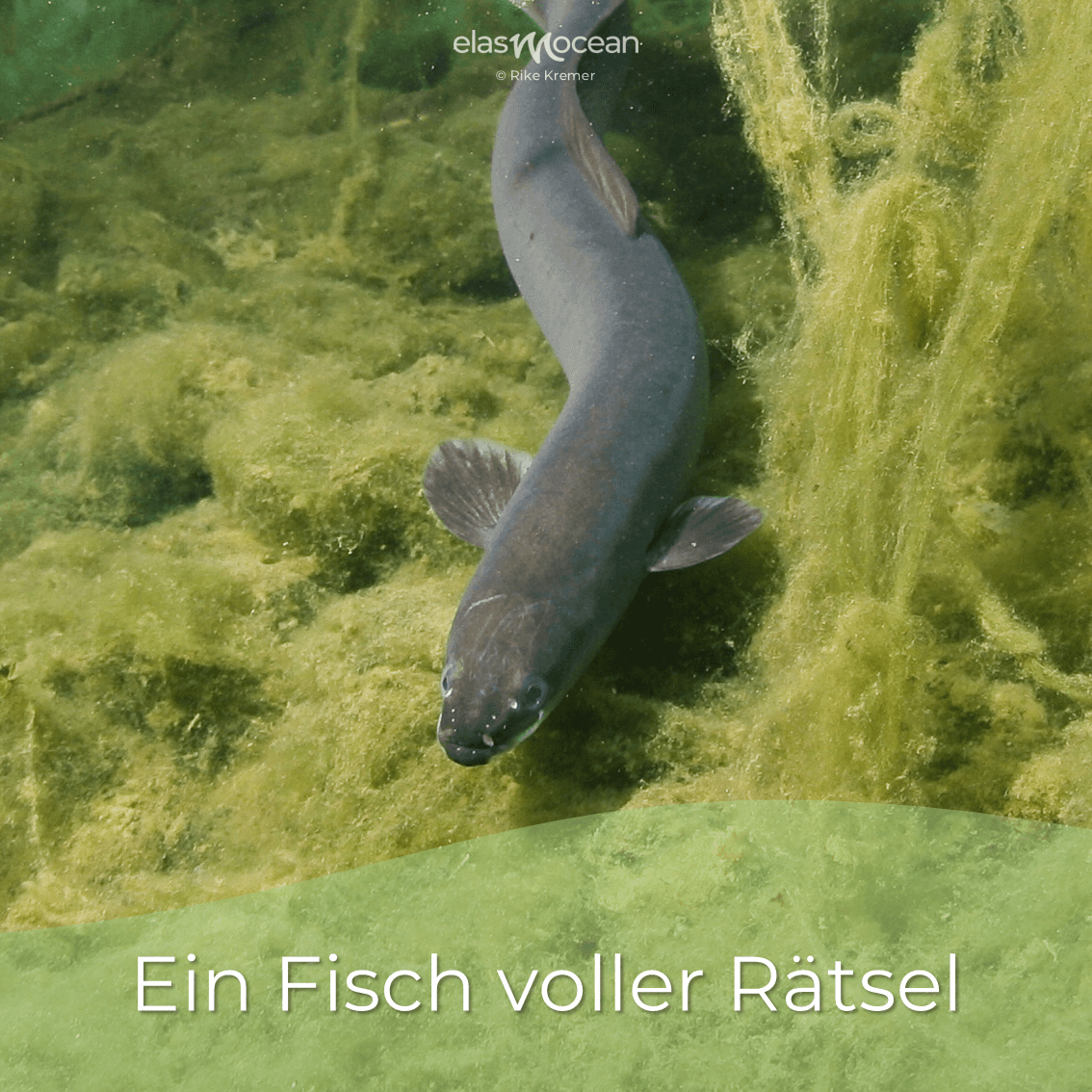
As today is World Eel Day, we would like to draw your attention once again to the great mystery of this fish. Although humans have been studying the eel since antiquity – and it was also systematically investigated during the Middle Ages – it remains not fully understood to this day how these animals actually reproduce.
At the very least, research no longer assumes that the eel is generated spontaneously from mud – as Aristotle suspected some 2,300 years ago.
What is truly fascinating is that the European eel (Anguilla anguilla) does not even possess reproductive organs while swimming through European freshwater bodies!
It only undergoes an astonishing physical metamorphosis during which sexual organs develop. Following this, it migrates to the Atlantic. Today, it is considered certain that the eel reproduces in the Sargasso Sea – an area in the western Atlantic, as the smallest eel larvae have been found there. However, the mating process itself remains hidden within the Sargassum seaweed – as described by Patrik Svensson in „Das Evangelium der Aale“.
Yet, as fascinating as the eel is – it is critically endangered. Intensive fishing, in particular, poses a severe threat to the species. Added to this are obstacles such as dams, locks, and weirs that block migration routes – as well as water bodies that are polluted or chemically contaminated.
These animals are unique, extraordinary – and absolutely worthy of conservation! Here are a few more facts so that you remember them beyond World Eel Day:
🔹 It takes approximately three years from the hatching of the tiny larva in the Sargasso Sea to its arrival as a glass eel in Europe.
🔹 Eels can even travel short distances over damp land – which is why they are found not only in rivers, but also in European lakes.
🔹 What triggers the eel to initiate its metamorphosis and migrate to reproduce remains unexplained to this day. This impulse can occur after eight, twenty, or even only after 80 years!
Sources:
Van Ginneken, V. J., & Maes, G. E. (2005). The European eel (Anguilla anguilla, Linnaeus), its lifecycle, evolution and reproduction: a literature review. Reviews in Fish Biology and Fisheries, 15, 367–398.
https://www.iucnredlist.org/species/60344/216177498