


It could be summed up quite simply: by setting catch quotas too high, EU fisheries policy has driven fish stocks in northern EU waters to the brink.
Looking at the sobering figures, it is clear that fish stocks have declined drastically over the past 20 years, despite the existence of catch quotas. How is this possible? The fisheries lobby versus reality is the simple answer. For years, scientists have denounced the excessively high catch quotas and the overly optimistic projections of fish stock development. Now, the GEOMAR Helmholtz-Zentrum für Ozeanforschung Kiel and the Christian-Albrechts-Universität zu Kiel have published an analysis that clearly proves: around 70 percent of commercially exploited fish stocks in northern EU waters are overfished or have completely collapsed, despite the EU's legal commitment to "sustainable fisheries", whatever they may mean by that.
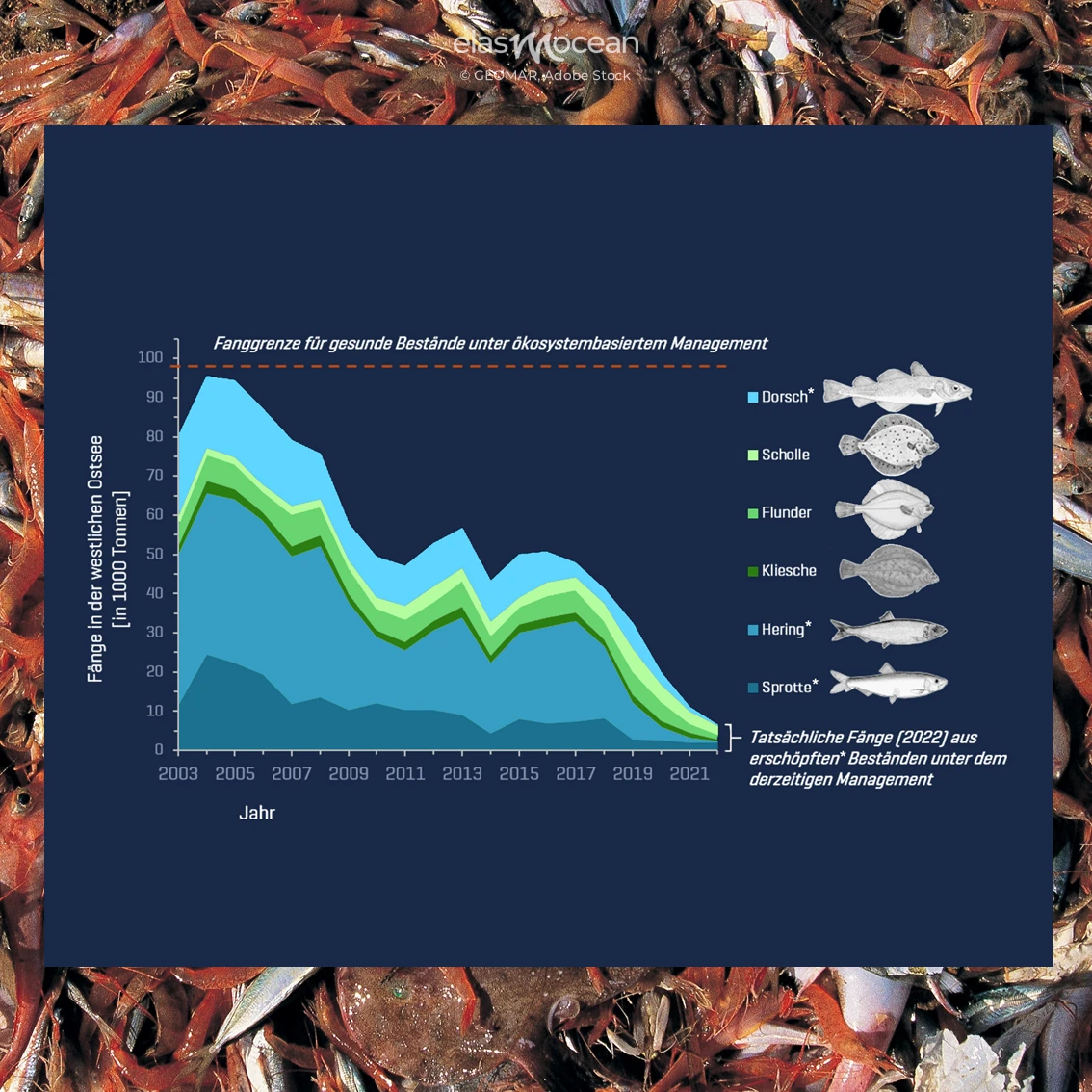
A case in point: eastern Baltic cod is already considered extinct. In the worst-case scenario, the western Baltic cod and herring face the same fate. The blame lies with continued overfishing despite extremely declining stocks. Prof. Dr Thorsten Reusch, Head of the Marine Ecology Research Division at GEOMAR: "It is the small-scale coastal fishers who suffer the most, often without having done anything wrong, except perhaps relying on political representation by fishing associations that lobbied for unsustainable catch quotas."
GEOMAR proposes an independent institution. Dr Rainer Froese, lead author of the study: "To be successful, such an body for sustainable fisheries would have to operate with the same level of independence as a central bank." And he emphasises: "In many cases, the implementation of sound scientific recommendations could lead to highly profitable fisheries from large fish stocks in healthy European seas within a few years."
The Thünen-Institut, however, criticises GEOMAR. "These GEOMAR authors have stood out for years with positions that are supposedly close to environmental organisations," criticises Christopher Zimmermann, head of the Rostock-based Thünen-Institut. It is true "that the uncertainties of our predictions have increased significantly, especially for Baltic Sea stocks - this has to do with climate change and eutrophication".
Where past fisheries policy has led refutes such remarks. One would assume that catch quotas actually take climate change and the specific situation of the Baltic Sea into account. This does not seem to be the case. Reality is now catching up with politics and confirming a completely flawed management of our sea on our doorstep. Instead of thinking conservatively and stopping overfishing to give the sea, and thus the fish stocks, time to recover, fishing continues.
Rainer Froese: "Interestingly, actual catches in the Baltic Sea usually remained below the permitted levels. This is simply because many fishers could not or did not want to catch more: searching for the last fish would have been too expensive and no longer profitable."
Further information and the corresponding analysis: https://www.geomar.de/news/article/warum-europas-fischereimanagement-neu-gedacht-werden-musshttps://www.science.org/doi/10.1126/science.adv4341


