


Welcome to our series "Our Lakes and Watercourses".
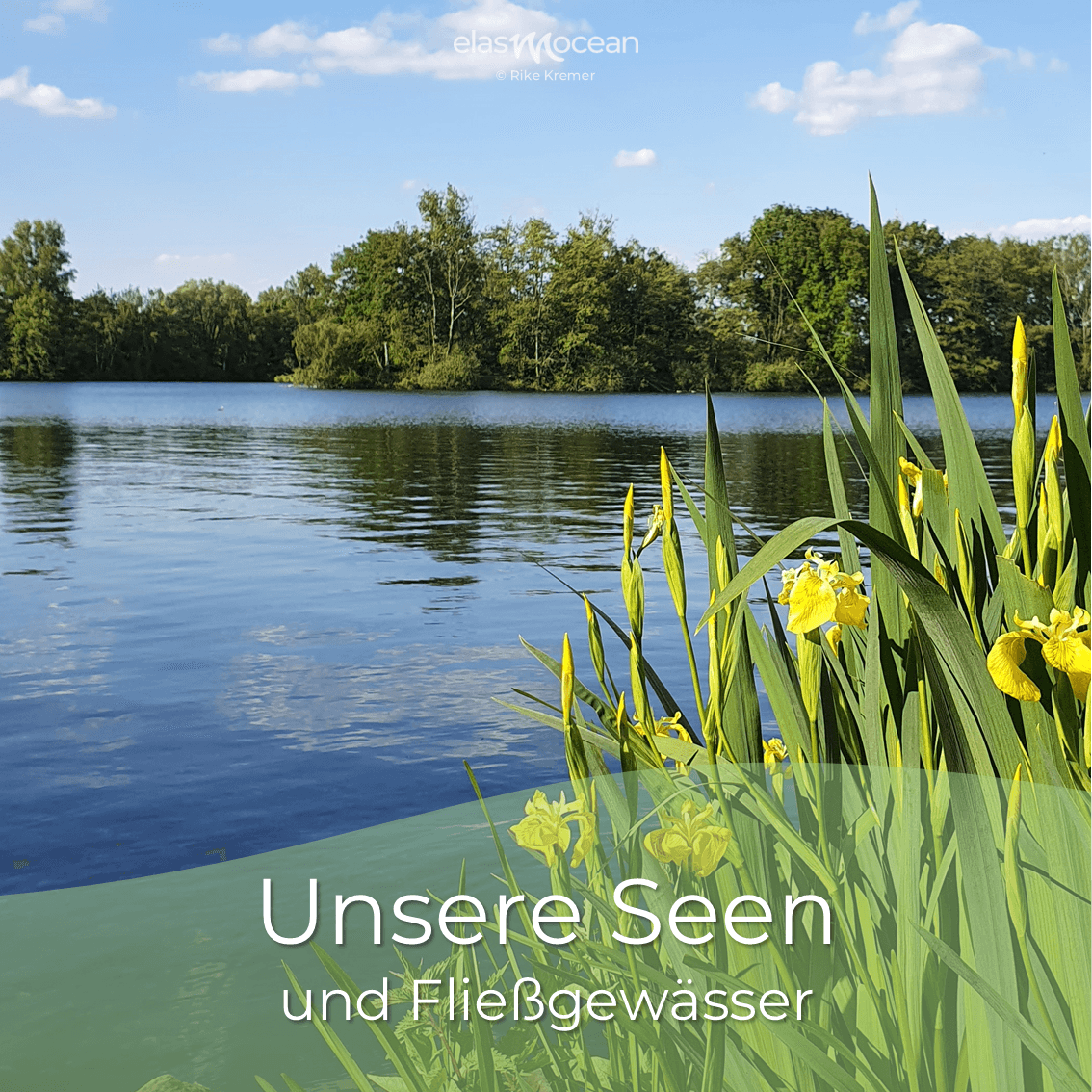
It may cover only a tiny fraction of our planet, but it harbours astonishing life: freshwater. Most people only view our local waters from the surface, often concluding that the water appears turbid and seemingly lifeless. But this is a fallacy. Every pond, every lake, every quarry, every volcanic crater lake, every river, and every watercourse is its own microcosm containing remarkable life. An entire, often self-contained ecosystem is hidden beneath the water's surface, with extraordinary animals and plants.
Only 0.3% of the water on our planet is freshwater and thus drinking water. Many of our lakes and reservoirs are therefore vital drinking water protection areas. However, looking at these waters in detail, one quickly notices that, apart from the rivers, there are very few natural bodies of water in Germany. The Mecklenburg Lake District is one such example, approximately 15,000 to 20,000 years old. It was formed during the Weichselian glaciation, the last ice age in Central Europe, and is embedded in a young moraine landscape shaped by ice sheets.
In Nordrhein-Westfalen, there is not a single natural lake. The waters closest to a natural lake are the volcanic crater lakes, the flooded volcanic craters of the Eifel. Many human-made waterbodies in NRW are quarry lakes, gravel pits, or reservoirs; each individual body of water has its own life and is highly vulnerable due to its often smaller size.
Let us dive into our waters, which are so close and yet so unfamiliar to many people.
The Food Web.
Phytoplankton, zooplankton, small fish, large fish, and apex predators define the food web, in the ocean as well as in our lakes. When the balance is maintained with a diverse variety of aquatic plants, the waterbody thrives. The normal lifespan of a lake is a good 30,000 years. Over time, it becomes increasingly nutrient-rich until it eventually turns into a bog. The ecological community adapts, new species arrive, others disappear. Eventually, a bog remains, which in turn is a unique biotope of its own.
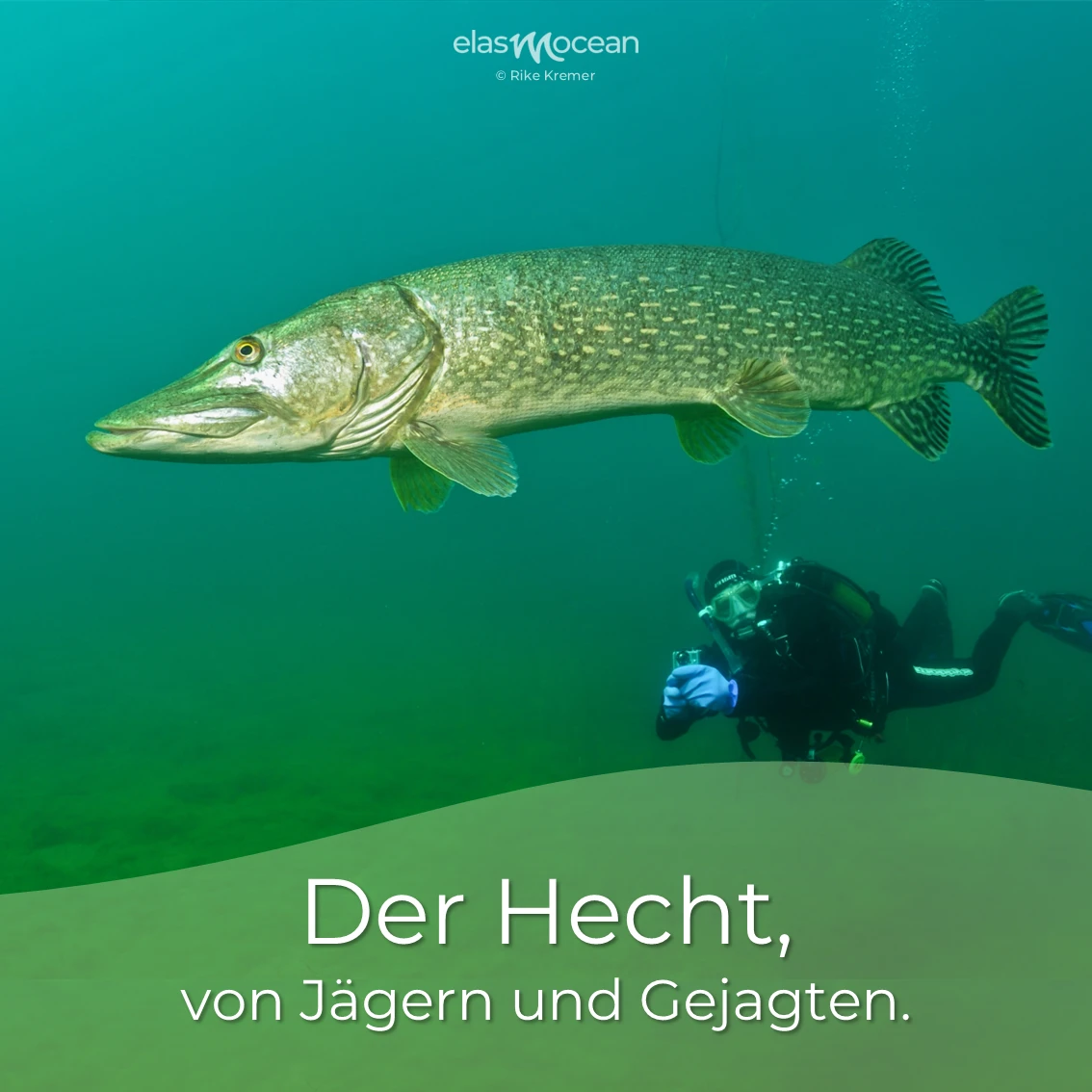
Phytoplankton (such as algae), zooplankton (such as bryozoans, insect larvae, and water fleas), and fish larvae provide the food source for all other species in the lake. Small fish such as young European perch, roach, and rudd are in turn prey for apex predators like wels catfish, northern pike, and zander. Foremost, the northern pike (Esox lucius) dominates our waters. It is an ambush predator with excellent camouflage: from stripes to spots, the skin reveals the age of the pike. The fewer the stripes and the more the spots, the larger and older the pike is. Female pikes reach sexual maturity at four years, males at two years. But caution is advised: since females grow significantly larger than males—up to 1.30 metres compared to the males' adult size of only about 90 centimetres—the males must be careful during mating in spring. All too often, the female devours the male afterwards.
Encountering an adult pike in our waters is a true experience. But here too, caution is required: pikes occupy territories and will defend them if necessary. If the mouth is opened wide, the pike is issuing a warning. Then it is time to retreat, even for divers!
The Perch.
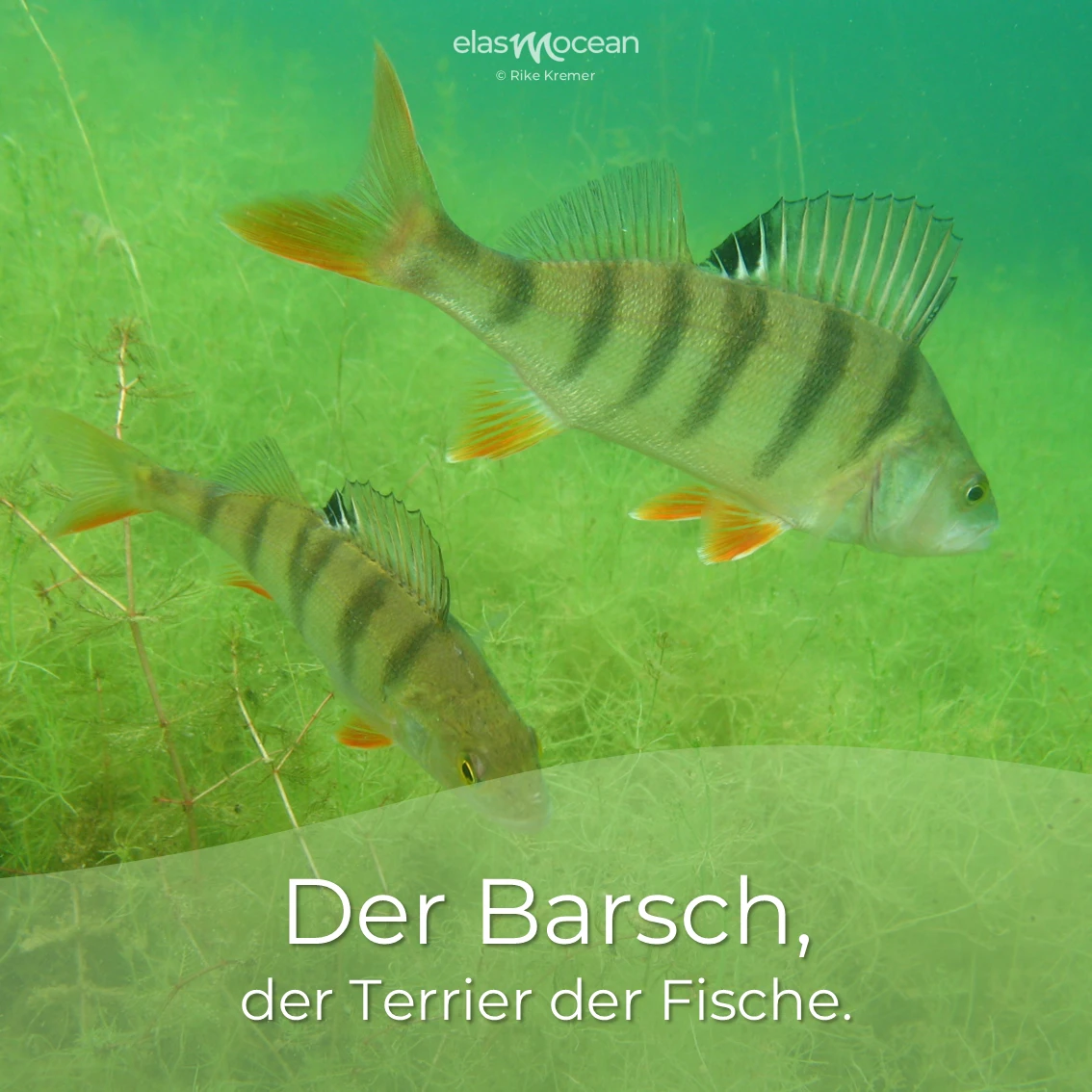
Which diver does not know it: the European perch (Perca fluviatilis). It is a sometimes quite cheeky fish, often not shy at all, and it even accompanies divers. It grows up to 40 centimetres in size and can reach an astonishing age of up to 20 years. Its larvae live on zooplankton in open water and return near the shore as juveniles. Perch are cannibals, so one can often observe the larger ones following the smaller ones. Their growth depends heavily on lake conditions. Under good conditions, a perch is fully grown at 8 to 10 years of age.
Hardly any body of water is without them. They are probably the most widespread and can be found almost everywhere. Since European perch have spines on their dorsal fins, which they erect in times of danger, pikes must always swallow them head first. If the pike has the perch crosswise in its mouth, it must turn it: often this is precisely the opportunity for the perch to escape its predator once more.
The Natural Wonder of the Eel.
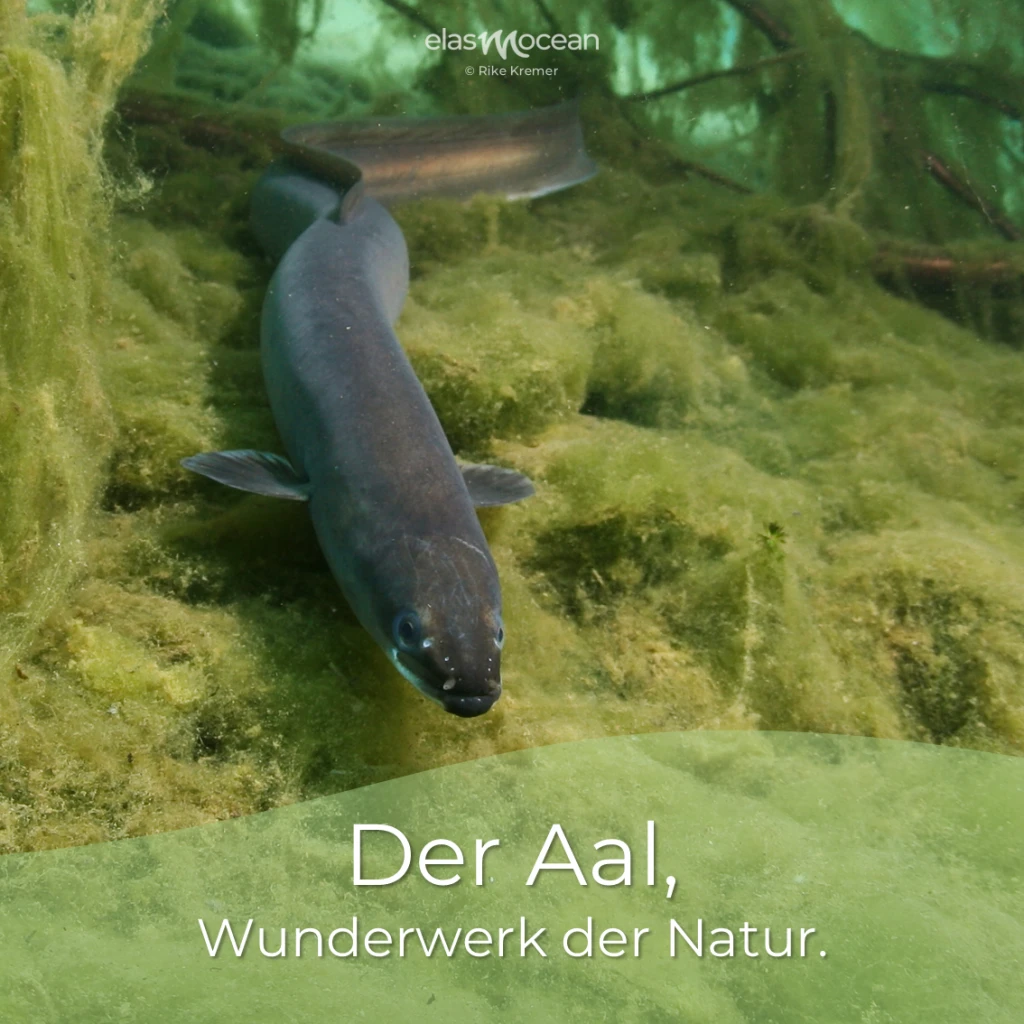
The eel is an absolutely fascinating fish and a true globetrotter. Its life begins in the Sargasso Sea, off the American coast in the North Atlantic. This is no joke: all European and American eels originate from this area. The European parent eels (Anguilla anguilla) have swum the vast distance from European rivers across the Atlantic to this location—over thousands of kilometres—to mate and subsequently die. The next generation of eels then begins a new life cycle. For between 5,000 and 7,000 kilometres, the larvae drift and swim with the Gulf Stream towards Europe over a period of years. There, they transform into so-called glass eels, but continue to live in shallow coastal waters for a while. Then, the eels leave the saltwater and migrate into the rivers, acquiring their typical dark coloration, and, if not fished beforehand, reach the river basins where they spend most of their lives.
After many years, towards the end of their lives, the eels migrate back to the sea and swim back to the Sargasso Sea to mate. The cycle begins anew.
Eels can live up to 80 years and, in damp weather, can leave the water and glide over land – a true marvel of nature!
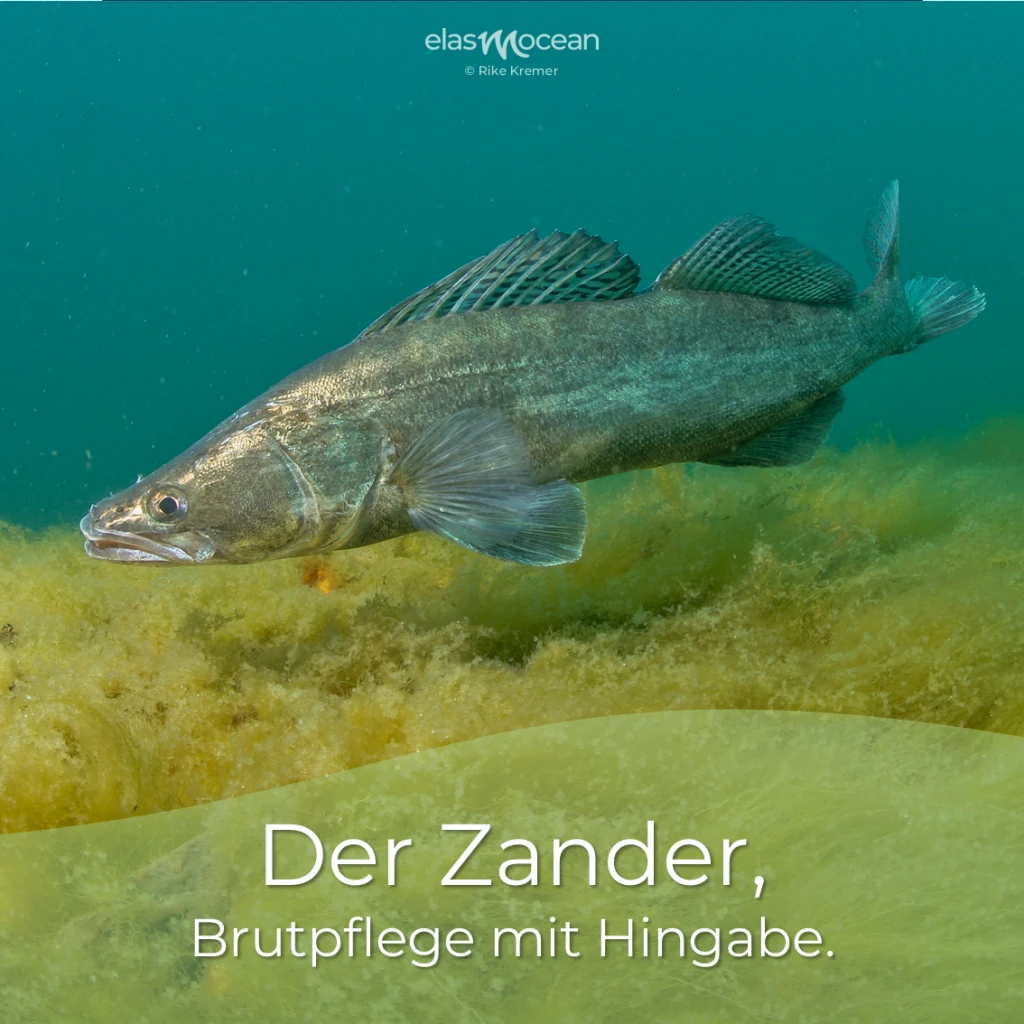
The Zander.
The zander (Sander lucioperca), like the European perch, belongs to the perciform fishes and is a brackish and freshwater fish. It colonises almost all rivers and large lakes in Europe; but the lagoons of the Baltic Sea are also its home. It hunts primarily in turbid, open water for small fish. It is very well adapted to brackish water and thus to poor visibility. As a diver, you will only discover it over its spawning nests in spring; the rest of the year, the zander spends in open water, hunting for fish or resting on the deep bottom. Parental care, which a zander pair shares, is highly energy-depleting after a long winter without prey; therefore, divers should not get too close to zander in spring, as they defend their nests quite aggressively.
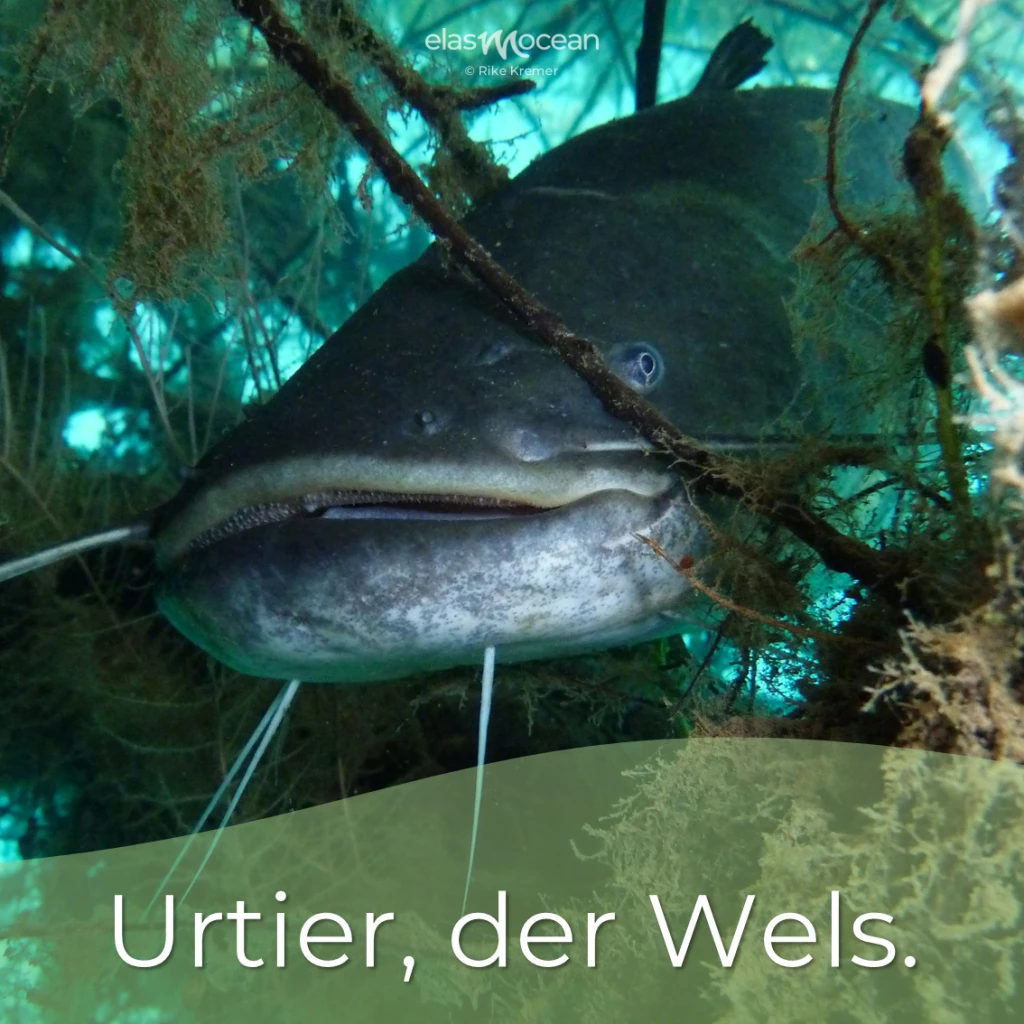
The Wels Catfish, the Primeval Beast.
There are police officers who draw their service weapons when a wels catfish (Silurus glanis) does something completely natural: guarding its spawn. Admittedly, it appears a bit eerie, and its size—normally two metres—is also impressive, if not terrifying. And yet, it is one of the most fascinating apex predators in our lakes and rivers: a true survivor. It manages under the most adverse conditions, can live up to 80 years, and grows up to three metres in length. It grows throughout its entire long life.
The best time to observe wels catfish underwater is in spring. After mating, the male catfish guard the nests, which are usually located near the shore in warm surface waters. After a few weeks, the phase is over, and the fish retreat to deeper regions, or they simply lie (like the catfish in our picture) sleeping near the surface in the shoreline vegetation. Wels catfish are mostly active at night and suck their prey into their large mouths using negative pressure. This happens so quickly and forcefully that it is audible to divers as a bang underwater.
For the catfish, being an opportunist, selection is not particularly important, so even a waterfowl can occasionally fall victim if the catfish succeeds; the anecdote of the devoured dachshund is well known.
Killing a wels catfish with a firearm (as occurred in summer 2025) because it was defending its nest and bit a few swimmers is, in our view, completely excessive! Naturally, a catfish (like many animals and some humans) may robustly defend its offspring. The small teeth in its powerful mouth act like rasps and can cause skin abrasions, but nothing more. Thus, recreational pleasure is pitted against biodiversity. For ElasmOcean, the evaluation is clear: let us simply respect nature. Temporarily closing off the shoreline area for a few days would have sufficed until the catfish retreated with the larvae into deeper waters after hatching. It is its only habitat—for us, this specific area is truly not essential for survival during those few days, despite all understanding for leisure and fun!
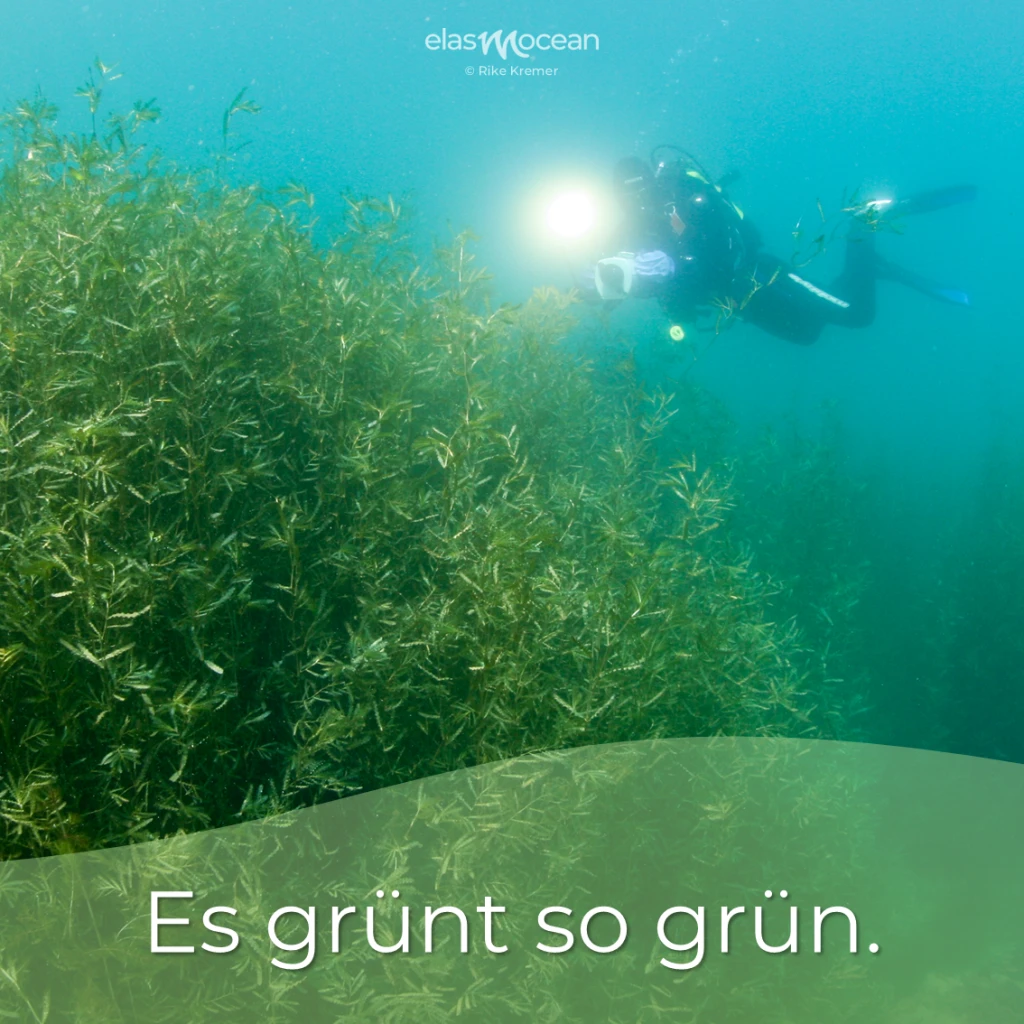
Plants in Our Lakes.
They are providers of oxygen, food, purifiers, and shelter; they offer cover, sustenance, and habitat: plant communities in lakes and rivers. Native plants like various pondweeds (in our picture: dense forests of curled pondweed) or milfoil, mare's tail, buttercup, rigid hornwort, and stonewort beds define the landscape in summer and autumn. Towards winter, many of them decay, but their roots survive and sprout again in spring, providing shelter and food.
They are essential for every lake. The species follow the nutrient content: milfoil occurs in nutrient-rich lakes, whereas mare's tail can easily survive in nutrient-poor mountain lakes such as the Samaranger See at the Fernpass in Austria.
The rule for all of them is that plants are opportunists: wherever an opportunity arises for a species, it grows, and displaces other plants if possible. Depending on the season, a lake can produce completely different plant communities, and even individual years sometimes differ greatly depending on the weather.
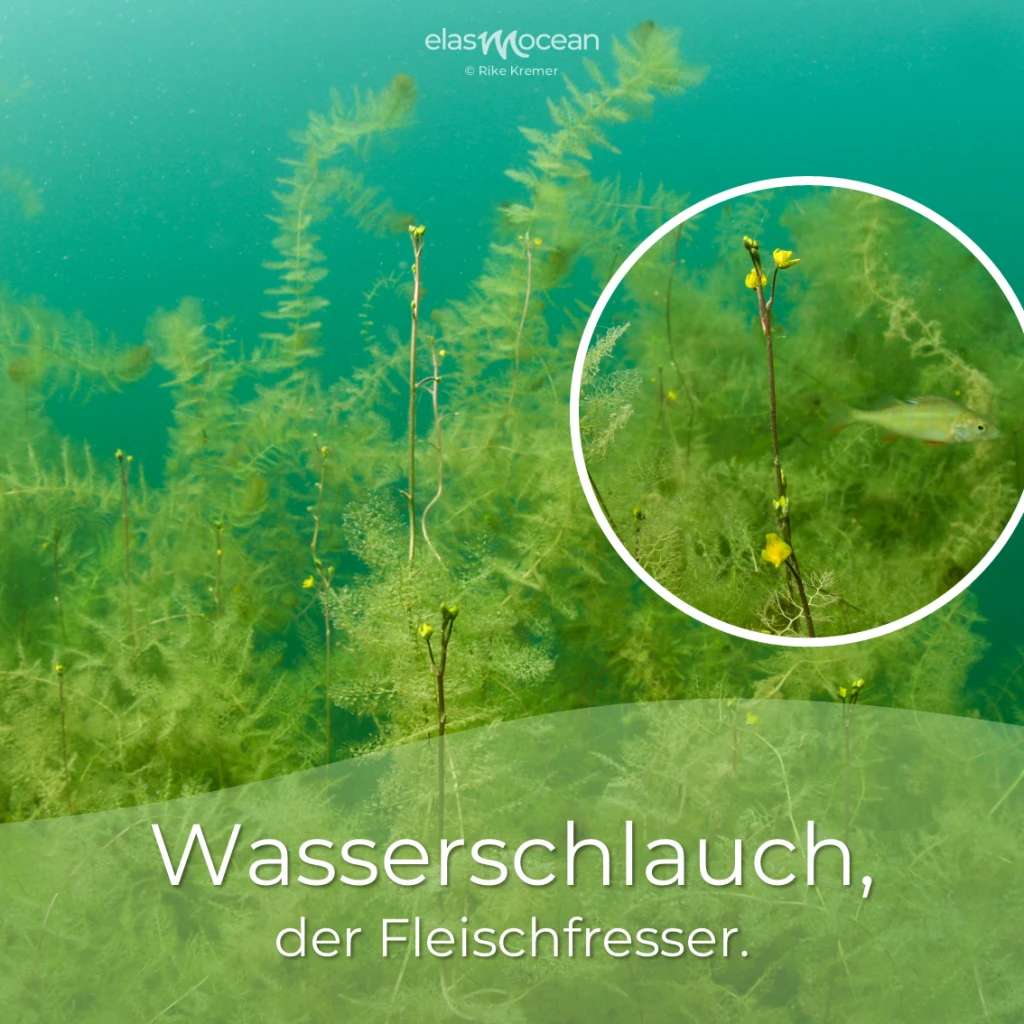
There Are True Wonders in Our Lakes.
The intermediate bladderwort (Utricularia bremii) is a carnivorous plant that particularly loves clean lakes rich in plankton. It has no roots but rather bladder-like traps that also serve as flotation devices: these small, bladder-like organs have a valve. When a small animal, such as a crustacean or a larva, approaches, it is sucked into the trap bladder in milliseconds. The valve closes, and the animal is digested. After two hours, the bladder is ready for use again.
For flowering, the bladderwort drifts to the water's surface and extends its flower stalks above the surface, where they are pollinated by insects.
It is on the Red List and is highly threatened!
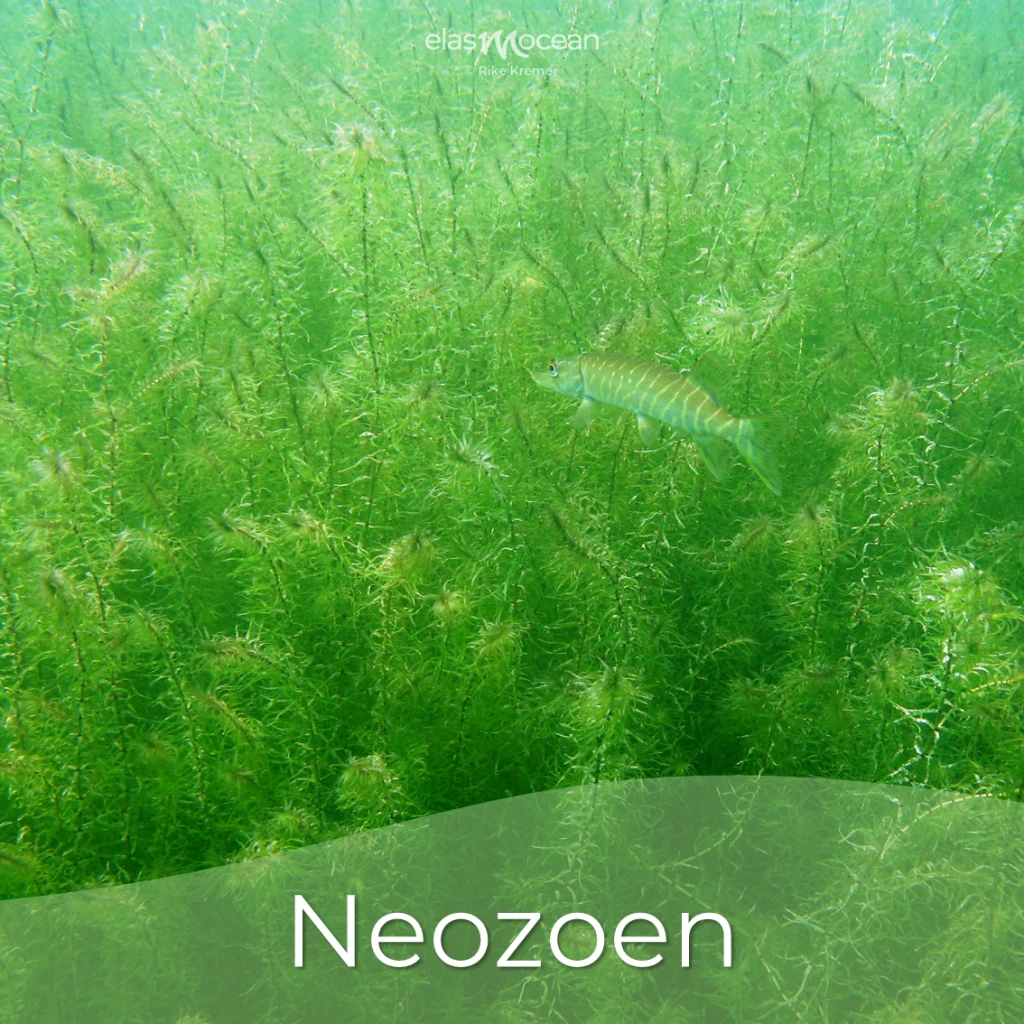
Waterweed and Co. – Neozoa.
Neozoa are introduced, invasive species that disrupt our ecosystems and sometimes dominate them entirely.
In our picture, you can see Nuttall's waterweed (Elodea nuttallii). It is one of the most widely distributed plants in our lakes and watercourses; however, it is relatively new to our region. It was popular in aquariums in the mid-20th century and entered our waters through the disposal of aquarium water and plants. It is an extremely invasive species with exclusively vegetative reproduction. Waterfowl carry this species in their plumage and faeces from one lake to the next. Nuttall's waterweed is extremely dominant and often overgrows all other plants before they can establish themselves permanently in our quarry lakes. Its "sister" species, Canadian waterweed (Elodea canadensis), is not quite as widespread but also dominates all vegetation once established in a body of water.
Comparatively harmless neozoa and also an indicator of good water quality are freshwater jellyfish. They were presumably introduced from Asia at the end of the 19th century.
Probably the most well-known invader is the spinycheek crayfish (Faxonius limosus), which killed almost the entire European crayfish population.
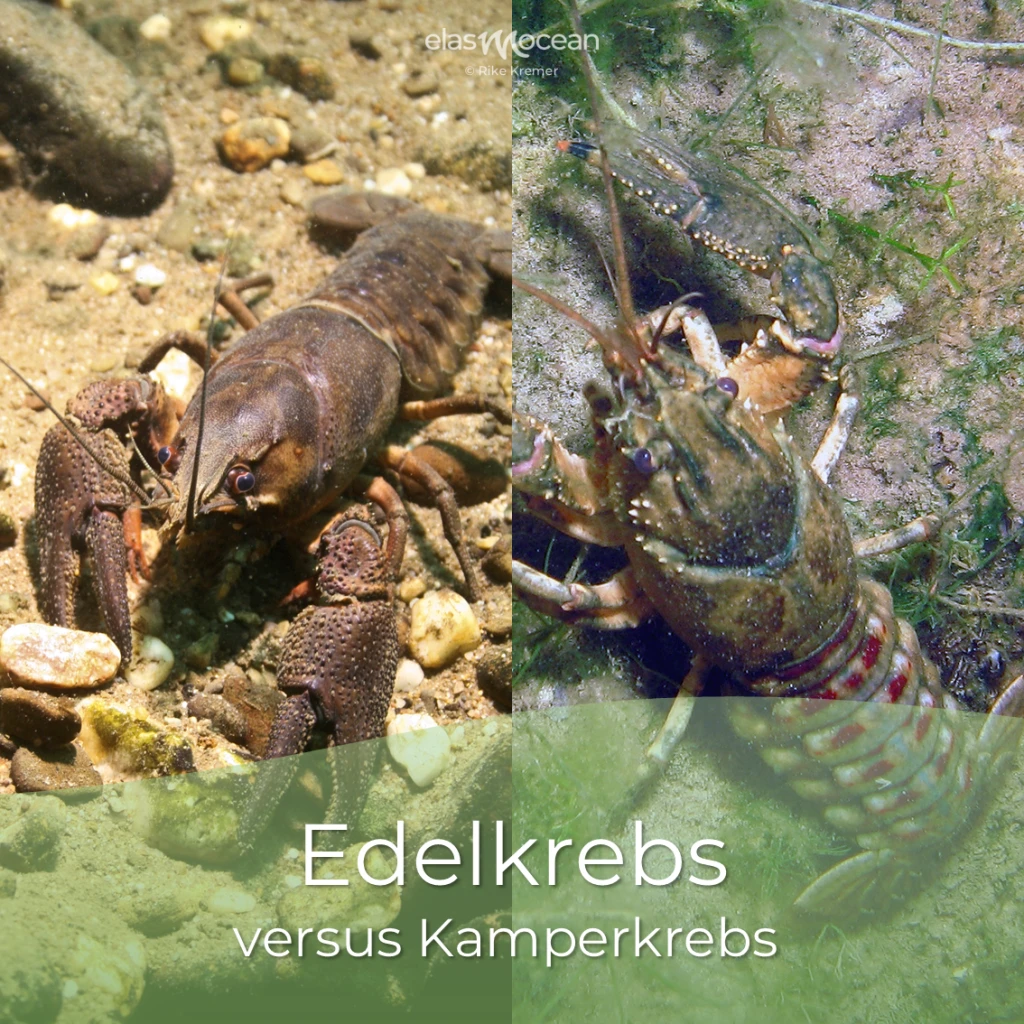
The Noble Crayfish.
Spinycheek crayfish, signal crayfish, calico crayfish, marbled crayfish, or red swamp crayfish: all are invasive species that have spread throughout Central Europe over the years. What they have in common is that they are carriers of the crayfish plague, to which they themselves are immune.
The tragedy began around 130 years ago. There are several European crayfish species: primarily the noble crayfish, the narrow-clawed crayfish, and the stone crayfish. While the narrow-clawed crayfish is naturally distributed in the Balkans, the noble crayfish occurred in all Central European waters. In the mid-19th century, the emerging middle class discovered the noble crayfish as a delicacy. A large portion of the native crayfish population ended up in the cooking pot. In 1890, the spinycheek crayfish was introduced from America as a replacement. It quickly occupied the newly created niche in the ecosystem.
What people at the time could not know: the American spinycheek crayfish carries a fungus on its body to which it is immune, but which is fatal to our native crayfish. Even worse than the plague of the Middle Ages (from which it gets its misleading name), this fungus kills all noble crayfish. Around 130 years later, the spinycheek crayfish has completely conquered the European habitat. It was followed in the 20th century by other invasive crayfish species, some of which were introduced through the pond and aquarium trade.
But they still exist, the quiet little spots where the world is still (or rather, again) in order for the noble crayfish. Only in isolated waters and in cold locations have noble crayfish and stone crayfish managed to survive in isolation to this day. These are isolated lakes, mostly nature reserves. They have also been actively reintroduced there, and in some lakes, such as the Plansee in Austria, native crayfish still occur naturally.
Urgently recommended precautionary measures for divers: before diving, enquire about any locally existing, endangered crayfish populations. For example, there are noble crayfish in the Sundhäuser Seen near Nordhausen in the Harz. If you have previously been in another body of water, completely drying your diving equipment before the dive is a must: dryness kills the spores of the crayfish plague fungus. If complete drying is not possible, the equipment should not be used for diving for 21 days, as the spores die off without a host after about 19 days.
Better safe than sorry - just once can be too much.
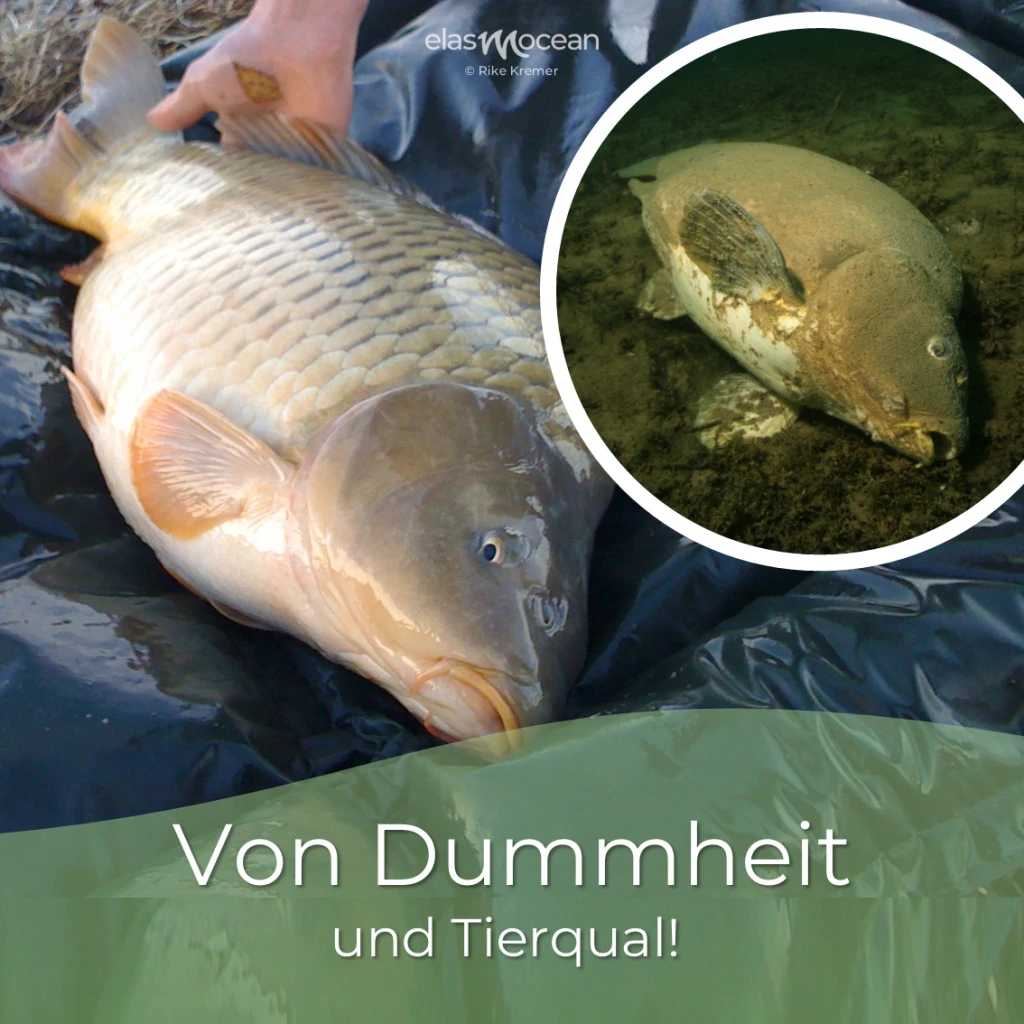
Carp Plague
What was a necessity in the Middle Ages is becoming a plague in the 21st century: the carp (Cyprinus spp.).
Monks transported carp from the Danube to our western regions centuries ago. Especially during Lent, they were a popular food. Since carp are highly resilient to polluted water and poor living conditions, the animals survived in proverbial "carp ponds".
Nevertheless, the common carp and the mirror carp are not native to our lakes. They belong in rivers, i.e., running waters and deltas. This applies even more clearly to grass carp and bighead carp. They originate from Asia and, with sizes of up to 1.5 metres, do not belong in our lakes at all. Nevertheless, they have been introduced for many years (mostly by angling clubs out of ignorance) as so-called "weed eaters".
The ecological damage is dramatic. The vegetation is literally eaten away, entire ecosystems are destroyed, and the bighead carp filters plankton from the lake in vast quantities like a miniature whale shark. The food source for all other species is thus lost. The common and mirror carp also turn many a lake upside down. This species can live up to 45 years and reach considerable sizes: some carp measure over a metre in length and weigh up to 40 kilograms. This attracts "leisure heroes" who believe they must catch the largest fish. The carp is just right for them. By law, any carp weighing over 2.5 kilograms must be removed and killed. However, this usually does not happen because it would prevent them from being caught again (and bragged about) in the future. The larger the carp, the prouder the angler, who, after up to an hour of "drill" (the repeated pulling on the fishing hook in the mouth), briefly treats the fish, proudly takes a photograph holding it, and then releases it back into the water. This is called "catch and release". According to some anglers, this constitutes "love of animals". We explicitly do not share this opinion: these animals suffer significant, seemingly endless agony and fear of death, and they still frequently die of exhaustion after release. The anglers no longer see this part—but divers find the dead animals on the lake bed.
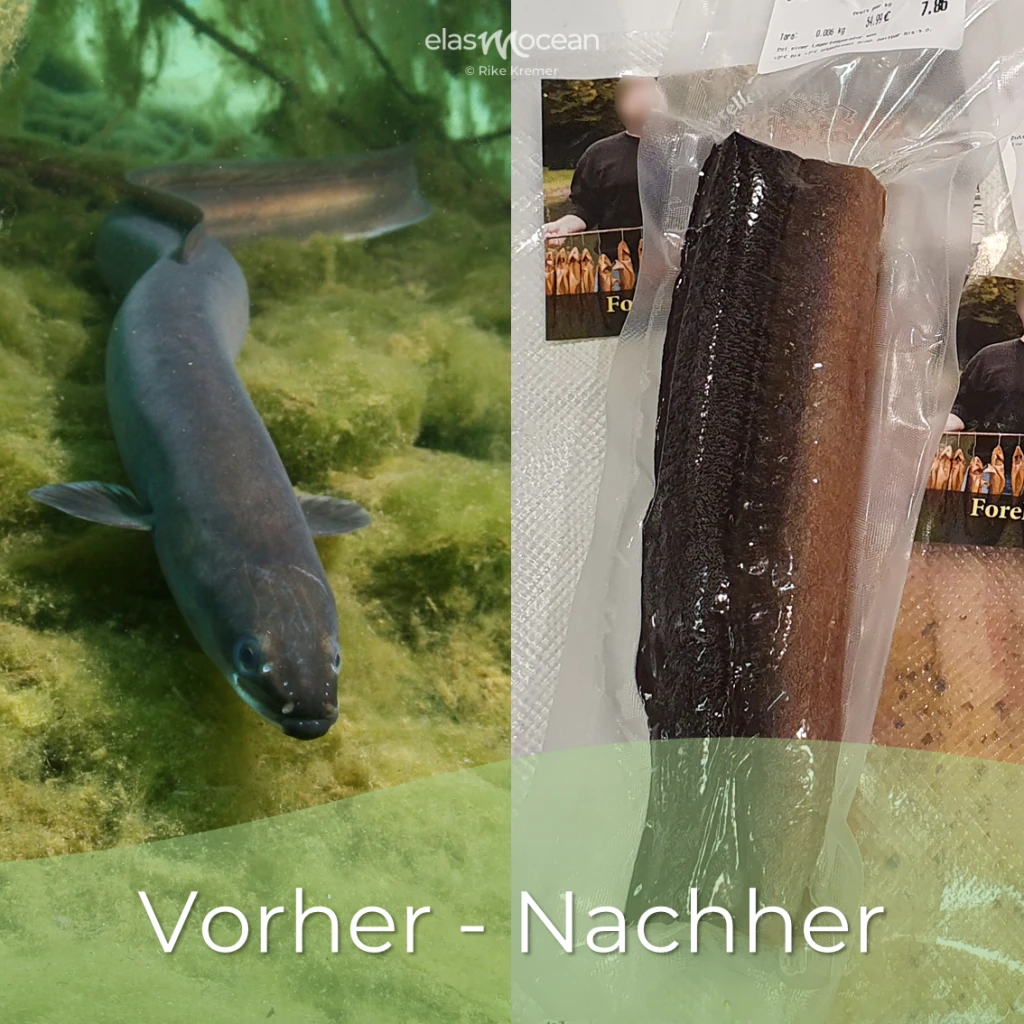
Ignorance, Before – After.
"I didn't know that!" is the standard response from most supermarket store managers when asked why, contrary to the directives of parent companies or franchisors, they continue to sell eel. Smoked eel repeatedly appears in refrigerated display cases. Alongside this ignorance of the staff, the excuse is often made that the contracted smokehouse offered it and delivered it together with other smoked goods.
Several retail groups such as Aldi Nord/Süd, Edeka/Netto, Kaufland/Lidl, or Rewe/Penny are fulfilling their responsibility and have permanently delisted eel—for good reason.
The European eel (Anguilla anguilla) is considered highly threatened: the IUCN Red List classifies it as "Critically Endangered". The Convention on International Trade in Endangered Species (CITES) lists it in Appendix II (trade only permitted after non-detriment findings). Since 2010, the import and export of European eels across the external borders of Europe have been entirely banned, and an export and import ban exists within the EU.
Eel cannot be bred in aquaculture. The already described, complex biology of this cosmopolitan animal prevents it. Not only is the meat popular as "smoked eel" in Europe, but the so-called "glass eel" (the juveniles illegally fished in European coastal waters) is also considered a delicacy in Asia.
What can every individual do to combat the endangerment of the eel? Keep your eyes open in the supermarket: if you spot eel in the refrigerated section, politely point out on-site that this animal no longer belongs in trade. Especially with retailers belonging to the companies mentioned above, referring to the guidelines of the contractual partners is helpful. Our "after" photo was also taken in a store of these chains, whose retailer had no idea what they were doing. In the meantime, after repeated requests by ElasmOcean, this store is also playing by the rules.
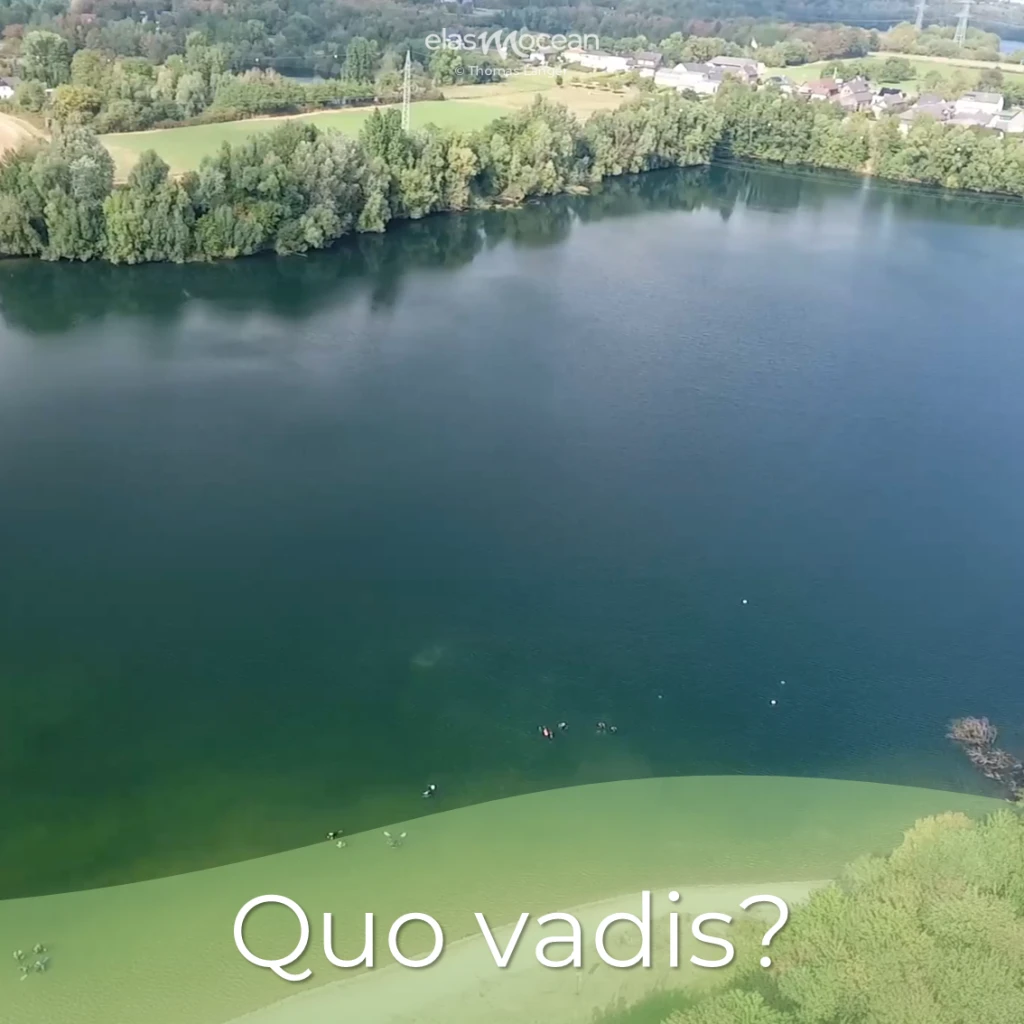
Where Are You Heading?
One is constantly tempted to ask this question of our lakes and watercourses. Much good is happening, but unfortunately, human egoism often prevails. Leisure fun versus nature conservation, self-interest versus animal welfare, ignorance versus consideration for animal welfare.
Every single visitor to the lake can do something: think and perhaps make a decision for the benefit of nature. Let us simply leave our lakes in peace. They are a small but fascinating habitat with large and small organisms that cannot escape. Precisely because this habitat is so small and therefore unstable and fragile, we must protect our lakes significantly better.
Our series could only provide a brief insight into the fascinating topic of "freshwater". There is much more to tell, which is why we offer workshops and lectures on this topic, covering in detail and in depth the beauty and the necessary protection of our waters. Inquiries regarding our lecture series are welcome at kontakt[at]elasmocean.org.


