


Two scientific research projects are currently investigating how Gannets are endangered by marine plastic and the origin of this plastic. ElasmOcean was on site to cover this research.
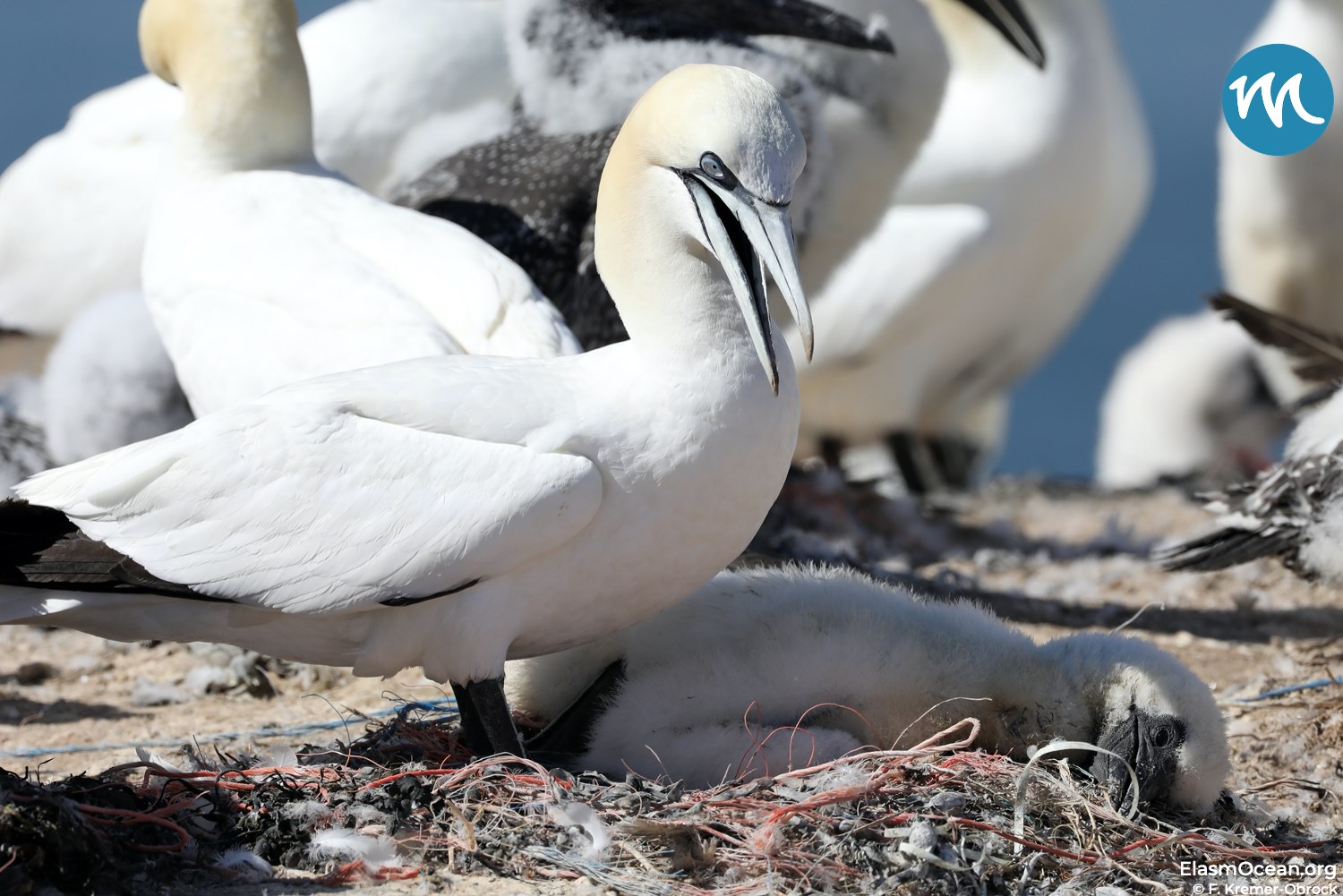
In his study "Basstölpel und Meeresmüll", ornithologist and environmental scientist Elmar Ballstaedt is investigating how plastic affects the lives of the large white seabirds on the Lummenfelsen on Helgoland. He observes that plastic pieces are increasingly being used for nest building - with devastating consequences. His study conducts research in cooperation with the Forschungs- und Technologiezentrum Westküste of the Christian-Albrechts-Universität zu Kiel (FTZ), the Verein Jordsand zum Schutz der Seevögel und der Natur e.V., the Alfred-Wegener-Institut Helmholtz-Zentrum für Polar- und Meeresforschung (AWI), the Institut für Vogelforschung "Vogelwarte Helgoland" (IfV) and the municipality of Helgoland. ElasmOcean is providing media support for this research project.
At the same time, the Thünen-Institut is researching the origin of individual pieces of plastic in the North Sea and how this can be prevented. The independent federal authority in Braunschweig uses scientific methods to investigate the origin, distribution and pathways, particularly of fishing nets, which are lost in whole or in part in the sea and travel long distances before either being ground down into microplastics or, indeed (and this is the link to the Gannets), being retrieved from the sea by animals, thereby posing other problems for the ecosystem.
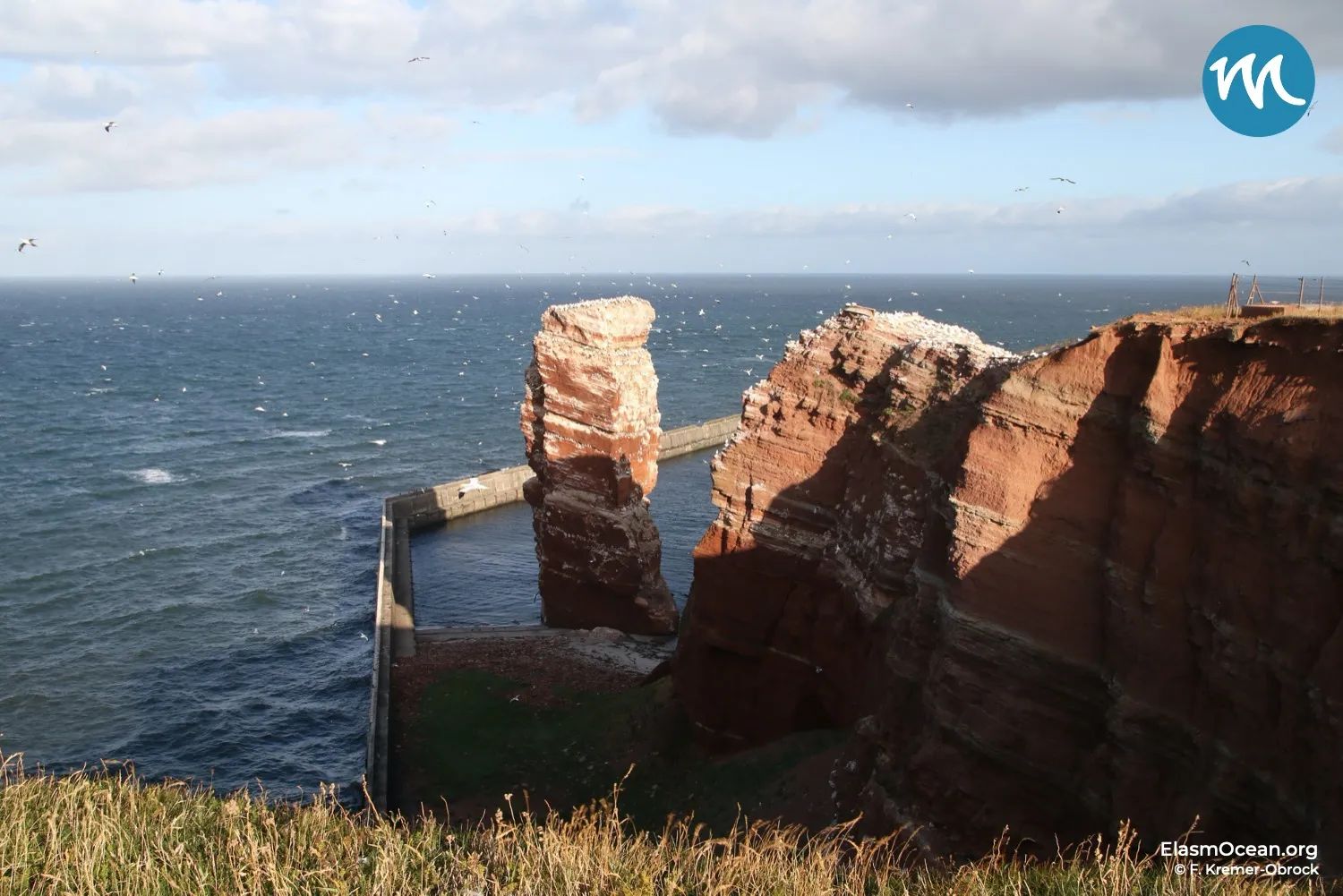
At the beginning of August, a five-member delegation from ElasmOcean set sail for Helgoland to visit Germany's only seabird colony. Our goal was to learn more about these wonderful and imposing animals, and to experience and observe them up close. The Verein Jordsand zum Schutz der Seevögel und der Natur e.V., represented by the scientist Elmar Ballstaedt, informed us about his project "Basstölpel und Meeresmüll". Alisa Rohrbach showed us the seabirds in action at the Lummenfelsen, and Damaris Buschhaus informed us on the Düne about their neighbours, the marine mammals.
The largest of the Lummenfelsen residents is the Gannet, which has been nesting on Helgoland since 1991. However, it is not alone there, but shares Helgoland's west coast with four other seabird populations: the Razorbill, the Black-legged Kittiwake, the Northern Fulmar and the Common Guillemot. They live on the cliffs simultaneously at times, as each species has its own requirements for space and food. All five species live peacefully together. To all of them, they only come to the island to breed and rear their young, otherwise spending most of their lives on the open sea.
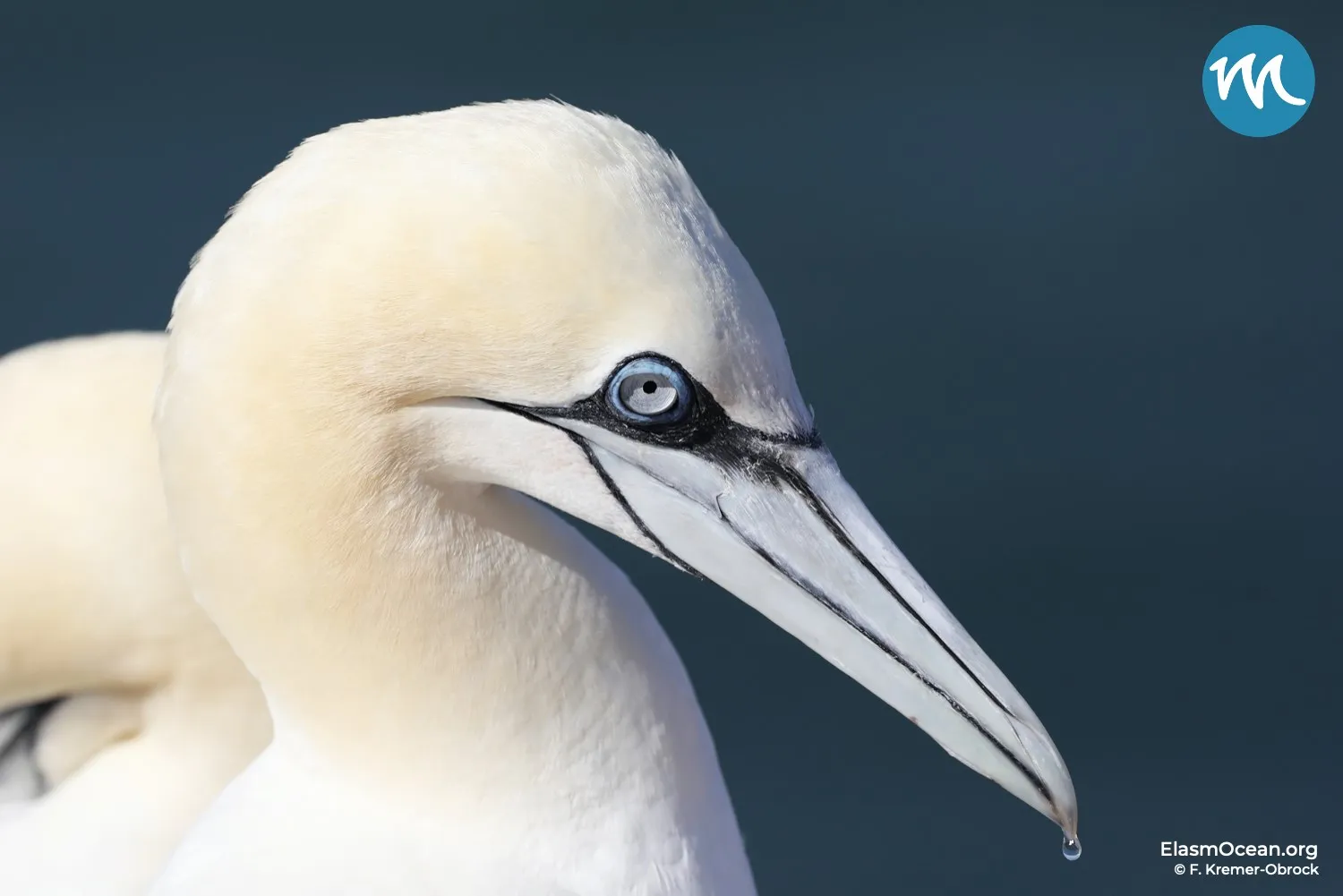
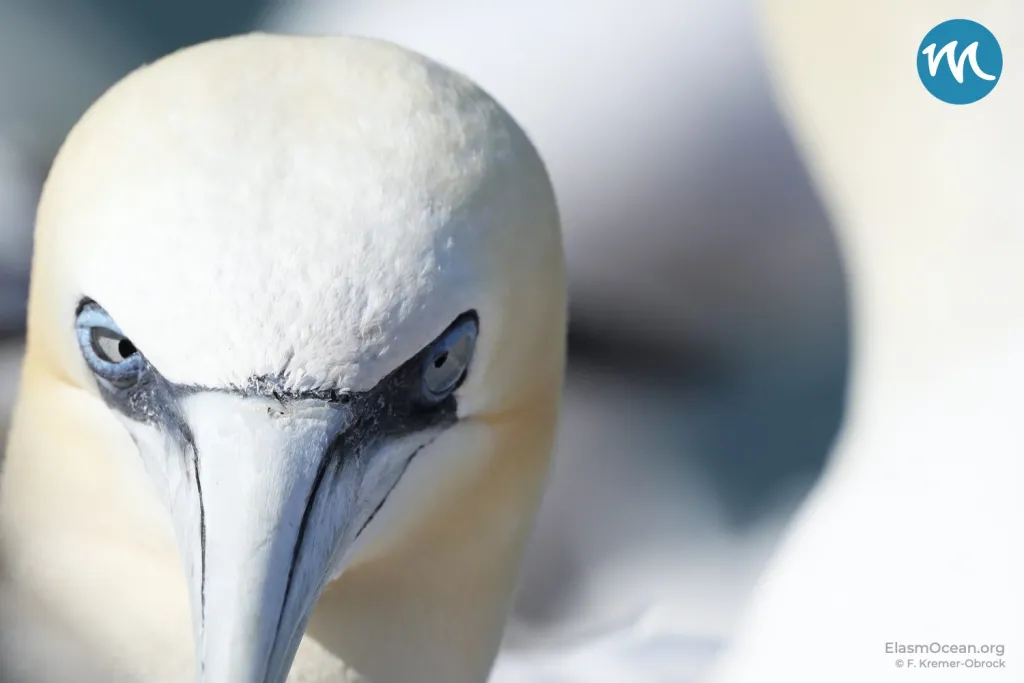
The Northern Gannet (Morus bassanus) is a goose-sized seabird that has also been living in Germany since 1991. The name is derived from the colony on Bass Rock in Scotland, which was described as early as 1448 - and from the seafarers' designation "Bobo", which can be translated as "fool". The gannet got this name because it liked to land without fear on fishermen's boats and thus ended up in their pan on several occasions.
It reaches a maximum weight of about 3-4 kilograms and an average age of 18 years. In the course of its life, it grows to a size of approx. 80-110 centimetres, with a wingspan of between 165 and 190 centimetres.
The Gannet only reaches sexual maturity at 5 years of age and then lives monogamously with its partner until the end of its life. Once a nesting site has been found, it is also reused every year. Year after year, the nest is modernised and, similar to birds of prey, always built "on top". Some old nests on Helgoland can weigh over 50 kilograms.
The Gannet's diet consists mainly of fish, which it catches by plunge-diving. In doing so, it folds its wings close to its body and dives like an arrow into the water at up to 100 km/h, reaching depths of up to 25 meters. When emerging, it then tries to grab a fish from a shoal. But similar to Skuas, Kittiwakes and various larger Gulls, as well as Fulmars, Gannets also exploit the source of food offered to them by offshore fishing.
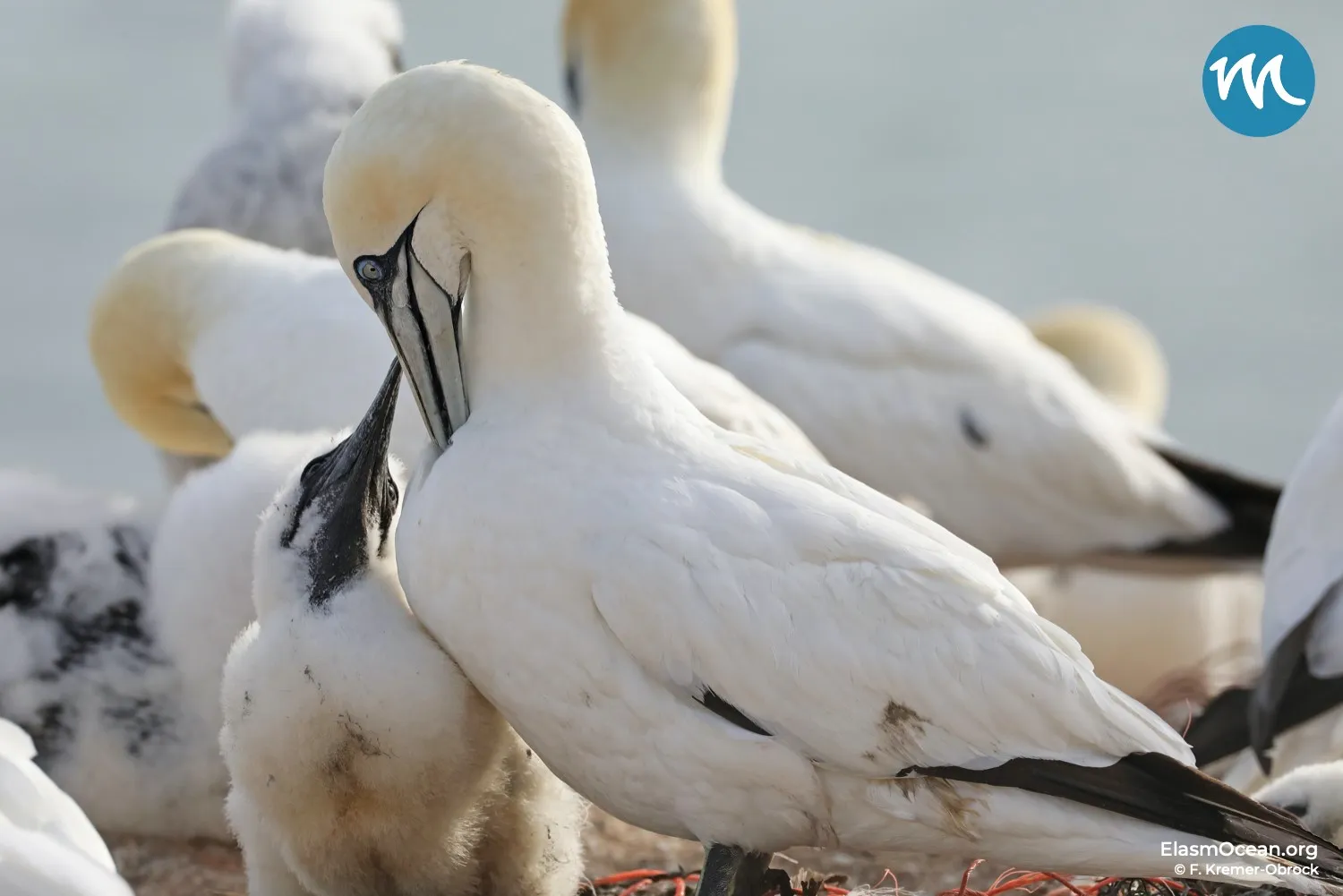
Every year in spring, the Gannets arrive at the Lummenfelsen nature reserve on Helgoland. The existing pairs modernise their nest from the previous year and, with any luck, lay an egg from which a young Gannet hatches after approx. 42-55 days. The young bird then needs another 84-97 days until it is large enough to leave the cliff itself. Immediately after hatching, the chicks are very small and weak, and so it often happens that the young gannets cannot yet lift their quite large and heavy heads and just lie there until they are stronger. During this time, the parents take turns caring for their offspring.
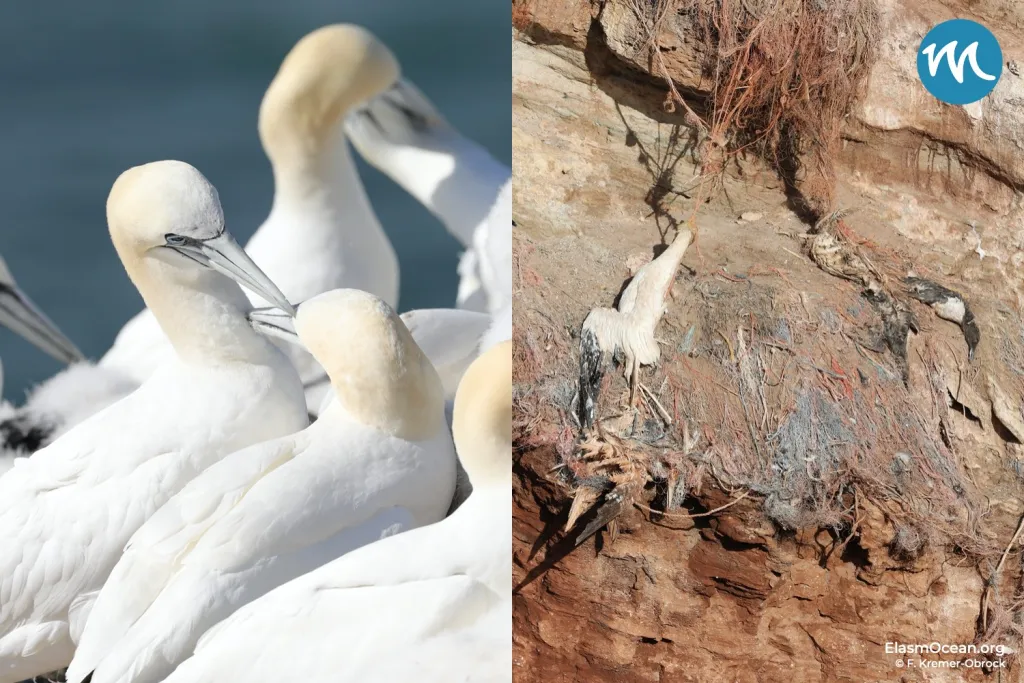
Each time a partner returns from foraging, the pair greets each other affectionately. Both stretch their bills upwards and rub them together. They repeat the same with their heads tilted downwards; their heads and necks often forming a heart shape.
Over the next few weeks, the young Gannets grow and their plumage develops: young Gannets are very dark at first compared to their older conspecifics. Over the first four years of life, their plumage becomes lighter and lighter until they develop the brilliant breeding plumage of adult Gannets. Young gannets can thus be easily identified by their black and white speckled bodies.
In 2020, 1,289 pairs bred on Helgoland. The year before, there were 1,206; in 2010, there were just 443 pairs. The number of pairs is increasing - although the colony is clearly receiving recruits from other colonies. Gannets only reach sexual maturity at five years of age and often only have one chick, so their own reproduction on Helgoland is not sufficient to explain the growth of the colony.
We have fallen in love with these wonderful creatures; how about you?
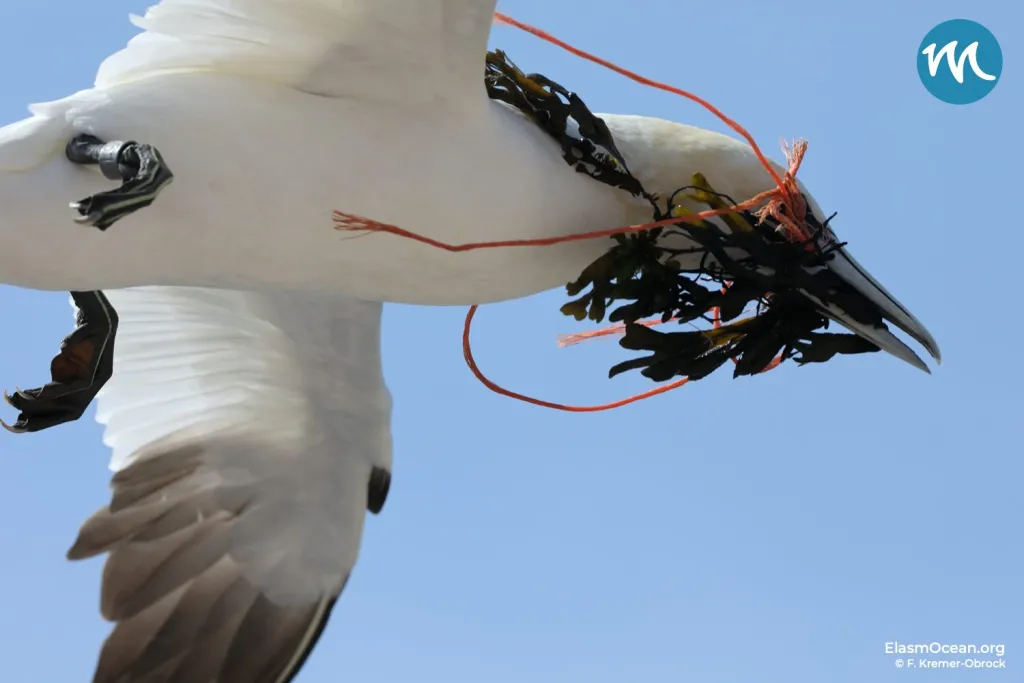
Our article is now changing tone. After all, we didn't just travel to Helgoland in August to watch seabirds – there is an environmental problem there that is the subject of the scientific research that ElasmOcean is accompanying.
Here is the ecological problem of the Gannets: they prefer to use the same nest every year. Since it is affected by wind and storms, the nests must be constantly "modernised" by their owners. For this purpose, the gannets require nesting materials, which they find primarily in the sea around the island. When the Gannets undertake their foraging flights of up to 300 kilometres, they also try to bring nesting material back with them. Natural materials include seagrasses and various types of algae.
Unfortunately, the animals do not only use natural materials, and plastic from the sea is found in about 9 out of 10 nests. This often colourful material is popular because its structure resembles natural materials and it floats accessibly on the sea surface. It barely decomposes, which is why some of the older nests now weigh over 50 kilograms – composed predominantly of plastic.
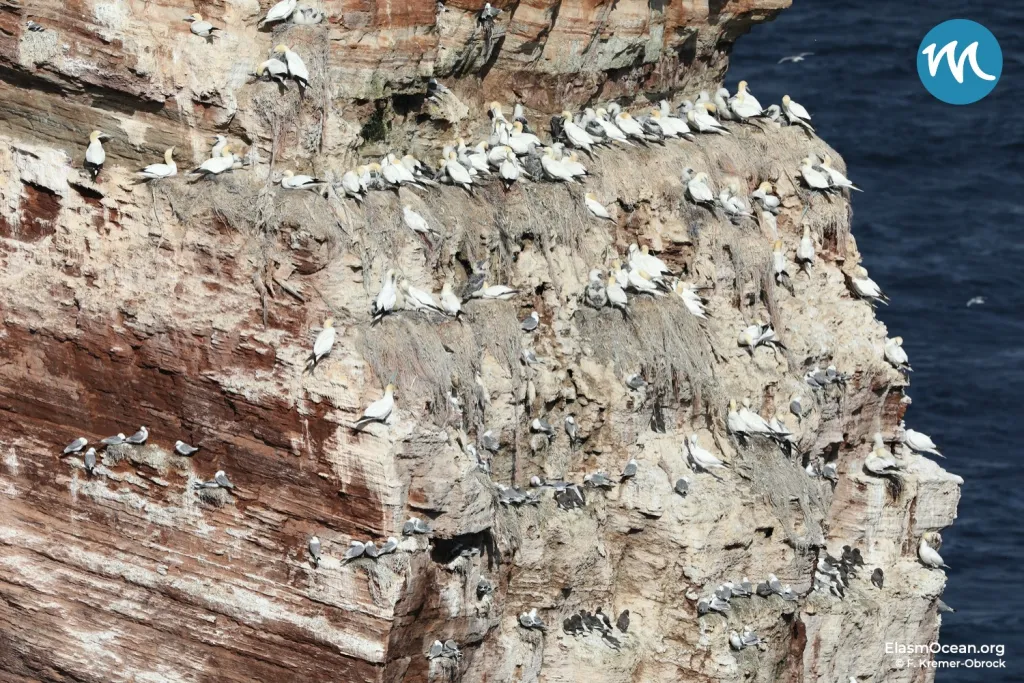
Unfortunately, the consequences are inevitable: time and again, the animals become entangled in the synthetic fibres – resulting in rapid strangulation or slow starvation, entangled and unable to escape. Certain death for the animals.
Every year, around 60 Gannets and around 100 Common Guillemots die on Helgoland. Some of the animals die quickly, but some death struggles last for days.
The attentive observer at the Lummenfelsen is faced with the question: "Can the animals be helped if noticed in time?" Unfortunately, the answer is a clear "no". This is because neighbouring gannet and guillemot chicks attempt to flee upon human approach, and thus plunge to their deaths down the 50-metre-high cliff, unable to fly.
Every year, around 400,000 visitors come to this beautiful island. Most only discover the beautiful sides of the Lummenfelsen, as day trips often leave little time. We looked closely at the Lummenfelsen for five days and had to make many sad discoveries, which brought a tear to our eyes.
Again and again, one can see Gannet families that have been torn apart – where the parents or the partner of the monogamous animals are still "mourning" at the nest, not understanding what has happened.
This brings us to the core of the scientific research: Elmar Ballstaedt is researching how plastic affects the lives of the large white seabirds on the Lummenfelsen on Helgoland, and what origin individual plastic parts in the North Sea have.
First interim results of the research are quite clear: it is specific parts of fishing nets that are used by the seabirds for nest building.
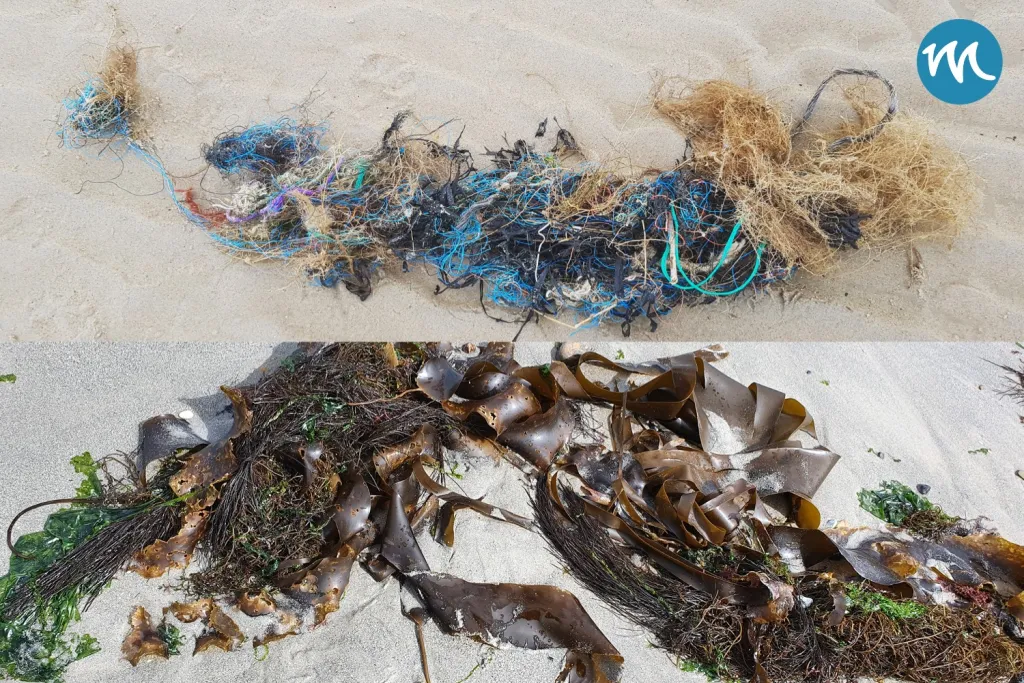
Anyone looking at the pictures in recent posts will notice that although there is a variety of different plastic in the nests, certain types obviously recur. These fibres are frequently used in bottom trawl fisheries and are called "Dolly Ropes".
Dolly Ropes are plastic fibres of various colours. One might think they are parts of the actual fishing nets – a variation of the ghost net theme. But far from it: Dolly Ropes are not accidental, unplanned and actually unwanted flotsam for the fisherman.
Instead, they are attached close together as additional tassels, so-called "abrasion protection", to the lower part of the actual fishing net. There they scrape along the seabed to protect the actual net from wear and tear. In return, however, the Dolly Ropes wear out: they fray, tear off the net and remain in the sea water. They drift around until they are washed ashore - or indeed, until they are fished out of the sea by a Gannet, for example.
The image above shows the comparison of natural and unnatural nesting materials.
This is the preliminary end of our report on "Gannets and Dolly Ropes - Helgoland's Plastic Problem". We have presented the life of the Helgoland Gannets and shown that there is also plastic waste in the oceans that does not result directly from litter – and that does not happen far away.
Evidently – the interim research results support this thesis – there is a plastic problem on Helgoland from additional fibres of the large fishing nets. These are two aspects that were also new to us.
We will stay on the case – we continue to support Elmar Ballstaedt's research in the media – more about his research from his project site: https://www.basstolpel-und-meeresmull.de. In addition, we are contributing dolly rope samples that we collected in Holland and Northern Germany. #OceanProtectionThroughKnowledge indeed.
We hope to have raised awareness of this issue. It seems that our own regional fish consumption is also a contributing cause of plastic waste in the sea – and this also has an impact on the wonderful large seabirds on Helgoland. We should reconsider this and think about if and how we can achieve a change here.
ElasmOcean will commit to this – are you with us?
"/>"/>


