


The Sixth Assessment Report of the Intergovernmental Panel on Climate Change (IPCC) consists of three parts: 1. The physical science basis; 2. Impacts, adaptation and vulnerability; 3. Mitigation of climate change. The third part of the report was published on Monday (download here; English).
The key message today is: "There is hope" – we can still achieve the necessary reductions in greenhouse gas emissions. Some of these measures are highly viable.
The report analysed mitigation pathways for various sectors, weighing different parameters against each other: which behavioral changes achieve what reduction, and what are the costs associated with the necessary transitions?
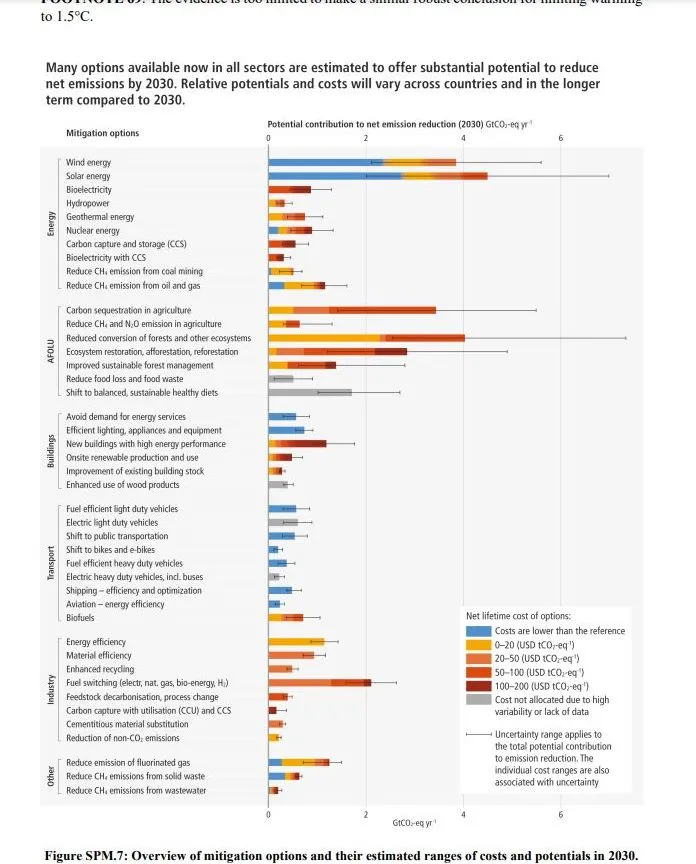
Excerpt from p. 50 – mitigation options, their potential contribution, and their costs.
This analysis demonstrates that the easiest major steps are possible in the energy sector: transitioning to renewable energy source achieves significant mitigation, and – particularly notably – is even more cost-effective than generating electricity using fossil fuels or nuclear energy. This means that we retrieve both greenhouse gas mitigation and economic savings simultaneously through a single measure: solar and wind energy.
The transition in the agricultural sector is more complex. On the supply side, simple, low-cost measures yield minor mitigation; large-scale transformations are associated with high costs. However, demand-side measures offer potential: a substantial reduction in meat consumption by consumers yields high mitigation and improves health outcomes. A reduction of 40–70% in agricultural emissions is achievable, whilst dietary costs are reduced, meaning this measure achieves significant progress at a low cost.
In the buildings sector, effective thermal insulation of buildings and behavioral energy conservation are pathways to substantial yet cost-effective mitigation. In the transport and mobility sector, simple and cost-effective options exist, but their total projected contribution to emission reductions is of secondary scale.
This contrast with the industrial sector renders the report politically sensitive: in industry, virtually no low-cost mitigation options exist; achieving the required transformation will be highly capital-intensive. Consequently, a major challenge remains in developing innovative, system-wide approaches, because quick and inexpensive options will not suffice in the medium and long term. In a few years, addressing these complex and capital-intensive tasks will become inevitable.
For these to remain a realistic pathway to achieving the necessary carbon neutrality, other mitigation options must be implemented immediately. If we neglect these options today, it will be too late to initiate them in a decade, and any pathways then remaining would restrict living standards in a manner we cannot impose on future generations. The Klimabeschluss des Bundesverfassungsgerichts assigned us this responsibility: the freedom of future generations is either secured – or prevented – by our actions today.
ElasmOcean therefore calls upon policymakers to rigorously implement state commitments made under the 2015 Paris Climate Agreement, and urges both decision-makers and citizens to take all measures within their power to implement the straightforward steps immediately and to address the more challenging pathways with clear focus.
For us and for the future.
There is still hope.


