


Strictly speaking, the Maldives had declared a marine protected area and environmental sanctuary, serving as a global model for over a decade. This became history in November 2025, when longline fishing for gulper sharks (also known as the common gulper shark, Centrophorus granulosus) was reauthorised in Maldivian waters. Gulper sharks inhabit the deep sea, but longlines do not select which animals they catch. Furthermore, fishers are evidently accepting and exploiting this bycatch very efficiently – finning has resumed: sharks have their fins sliced off while still alive to be sold to the Asian culinary market. Deprived of their fins, the animals are thrown back overboard and usually die a slow, agonizing death. Recently, reports of incidents in the Maldives have been increasing, affecting other shark species as well, such as finned oceanic whitetip sharks.
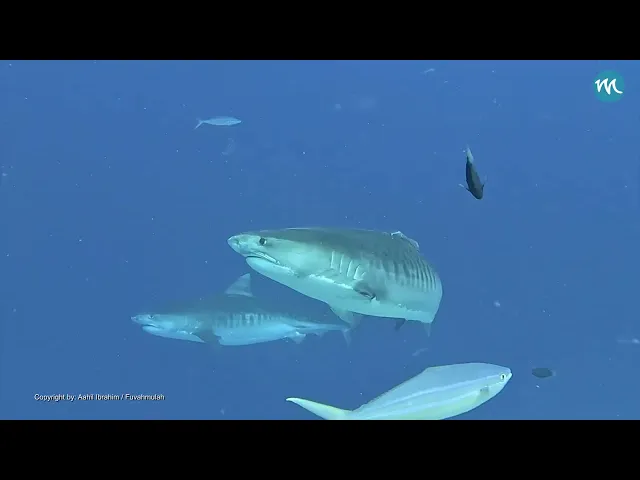
Our video was recorded by local marine biologist Aahil Ibrahim on 12 February 2026 off the island of Fuvahmulah (Maldives). It shows a female tiger shark missing its dorsal fins, one pectoral fin, and the lower lobe of its caudal fin – the "clean" cut edges clearly indicate that this was not caused by accidents, but by a sharp human knife. The local divers who captured this footage have named her "Fin" and continue to monitor her. Another female tiger shark was recorded off Fuvahmulah by local marine biologist Luca Asshauer, with whom ElasmOcean collaborates. She was missing her dorsal fin and, like "Fin", the lower lobe of her caudal fin. She has not been sighted since. "Fin" has now been surviving with this handicap for several months, demonstrating the resilience of tiger sharks (Galeocerdo cuvier).
It should go without saying that ElasmOcean condemns finning in the strongest possible terms. We call upon the government (as well as law enforcement and the courts) of the Maldives to actively and effectively combat this egregious cruelty to animals. Selective longline fishing is an impossibility: any unregulated line fishing, where countless hooks are dragged through the sea, inevitably generates "bycatch" that too frequently violates international treaties such as the Washington Convention on International Trade in Endangered Species (CITES) and is consistently inhumane and unethical towards marine wildlife.


