


By 2050, approximately 10 billion people will live on our planet. This also has consequences for the oceans: recently presented projections by the Alfred-Wegener-Institut (AWI) at a marine conference organised by the Bundesverband Windenergie Offshore e.V. (BWO) clearly illustrate this dilemma.
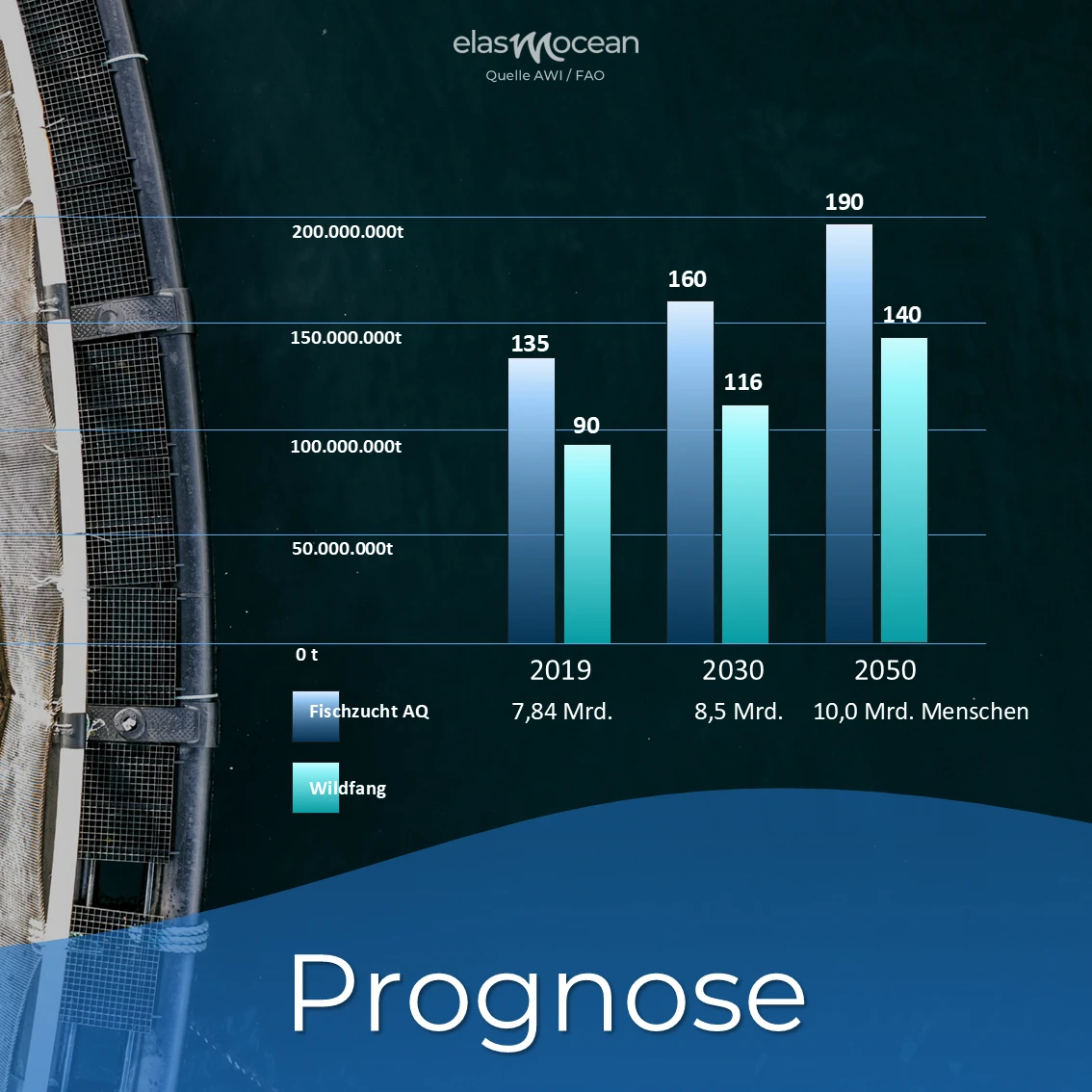
From a global perspective, fisheries and aquaculture appear at first glance to be becoming increasingly vital. Currently, around 90 million tonnes of fish are caught in our oceans by industrial fisheries; these figures have been stagnating for years. A further 95 million tonnes of fish are farmed through aquaculture, showing a continuously rising trend. Added to this are 40 million tonnes of algae, with China being the world's largest aquaculture producer. Based on calculation models, to maintain current consumption levels, aquaculture would need to be increased to 190 million tonnes and wild capture fisheries in our oceans to 140 million tonnes by 2050. These are the statistical projections.
Another notable value is a date: the annual German Fish Dependence Day was reached as early as 29 February in 2024. In 2025, it occurred one week earlier. From this day forward, statistically speaking, Germany imports fish for the rest of the year from other countries and thus from other fisheries and aquacultures.
In reality, an increase in wild fish catches is not possible. The fishing industry is already reaching its limits, and the oceans are known to be finite. A "business as usual" approach is therefore untenable. The same applies to aquaculture: its spatial capacity is limited, as is the feed, which in turn is largely sourced from wild fisheries.
One solution to the problem, however, remains completely ignored: redistribution.
If wealthy Western nations were to reduce their fish consumption or largely abstain from fish, this would benefit nations that depend on fish as a vital source of dietary protein. There is also a stark imbalance between countries in Africa and South America, where fish is a staple food despite relatively low yields from fisheries, and the luxury product fish in demographically declining countries with large industrial fisheries, which also includes several nations in Asia.
There are many reasons to abstain from consuming fish: alongside health implications and ethical concerns, we must regard the overfishing of the oceans as the primary argument against fish consumption and act accordingly.


